The Reliable Resource for Impartial Product Insights

Best 5 Indoor Air Quality Monitors of 2026: CO2, PM2.5 and Radon

Owen Carter
By Owen Carter – Research Specialist
Owen Carter is a research specialist at CompareLoft. He builds each guide by comparing manufacturer specifications, safety listings, warranty terms and patterns in verified buyer reviews. CompareLoft does not lab-test products; scores are editorial judgments based on that research. How we review
Updated October 2026

Most of us can tell when a room feels stuffy, but very few of us can tell why. Is carbon dioxide building up because the bedroom door has been closed all night? Did searing steaks send fine particles drifting through the house? Is humidity creeping up in the basement? An indoor air quality monitor turns those guesses into numbers, so you know when to open a window, run the range hood, change a filter or switch on a purifier.

Monitors differ widely in what they actually measure. Some focus on a single reading done very well, like a laboratory-style CO2 sensor. Others pack in particulate, VOC, humidity and even radon sensors in one box. Display style, power source, app quality and smart-home support all change how useful a monitor is day to day, and two devices that both claim to measure the same pollutant can use very different sensor technology.

To choose our picks, we compared manufacturer specifications, published sensor ranges and accuracy figures, warranty terms and recurring patterns in verified buyer reviews. We did not run lab tests of our own. Scores reflect our editorial judgment of how each monitor's documented feature set serves typical US homes, from apartments to houses with basements.

One note before you shop: these are informational devices for understanding your indoor environment. They are not certified safety alarms, so keep working smoke and carbon monoxide alarms installed as required where you live. With that in mind, here are the five monitors we think are worth buying in 2026.


Our Evaluation Standards


What it measures and how

We favored monitors that use NDIR sensors for CO2 and laser scattering for particulate matter, because those technologies measure directly rather than estimating. We also gave credit for broader coverage such as radon, VOCs, humidity and pressure.

Data and app experience

A monitor is only as useful as the history and alerts it gives you. We compared app features, data export, historical charts, notifications and smart-home integrations like Alexa, Google Assistant and IFTTT.

Display and readability

Some people want a glanceable screen on the counter; others prefer to check an app. We weighed screen type, size and clarity, and whether readings are easy to understand without opening a phone.

Power and placement

Battery-powered monitors can go anywhere, including bedrooms and basements without outlets. Plug-in models need a nearby socket. We considered battery life, portability and Wi-Fi requirements.

#1 TOP PICK
Airthings View Plus Radon and Air Quality Monitor
Image courtesy of Airthings

Airthings View Plus Radon and Air Quality Monitor

from Airthings
Rating
9.4 / 10
★★★★★
Sensor Coverage
97%
Data & App
90%
Display
84%
Placement Flexibility
90%
Value
84%

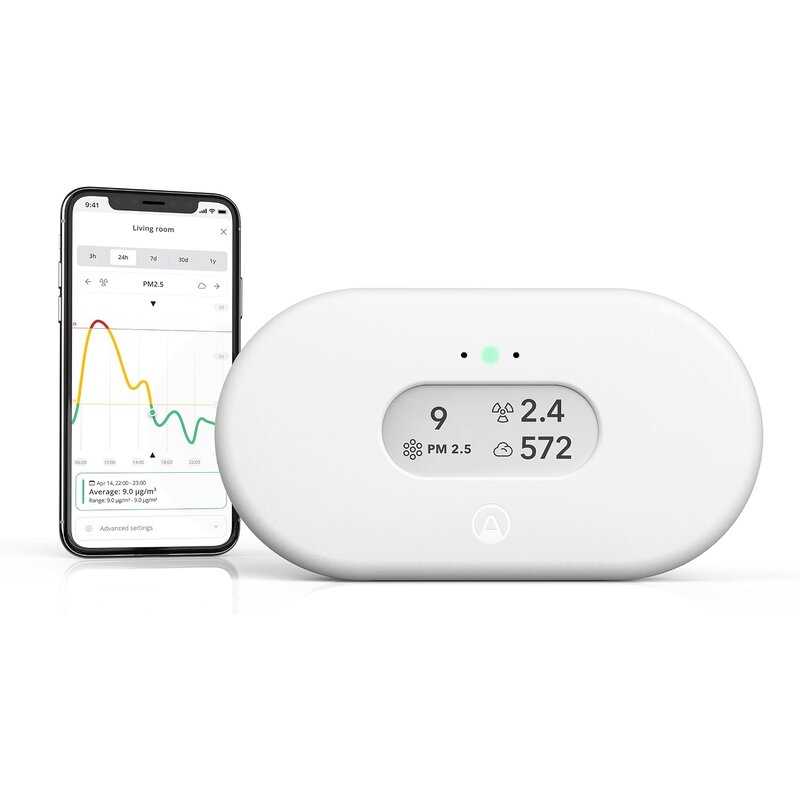
The Airthings View Plus is the most complete home monitor on this list, and the main reason is continuous radon tracking. Very few consumer devices combine radon with PM1 and PM2.5, CO2, VOC, humidity, temperature and air pressure readings, so for homeowners with a basement, or anyone who wants one device to cover everything, it removes the need for a separate radon detector. It reports eight readings in total, more than any other monitor in this guide. 🏠

Radon levels shift with weather and season, so a continuous monitor gives a far better picture than a one-time test kit. Instead of a single snapshot, you can see how levels rise and fall over days and weeks, which makes it easier to spot patterns in a basement or lower level and to judge whether conditions in your home are steady or changing. That longer record matters because a short reading can miss a seasonal swing.

The power design is unusually flexible. It runs on the included batteries, rated for up to two years depending on settings, or plugs in over USB. That means you can put it in a finished basement, a bedroom or a hallway without worrying about outlet placement, and move it later if you want to check conditions in another room. It also fits a shelf on a lower floor, where radon is usually the main concern. 🔋

Readings sync over Wi-Fi to the Airthings app and online dashboard, where you can see trends over days and months, while the customizable screen gives the rest of the household a glanceable summary. It also works with Amazon Alexa, Google Assistant and IFTTT, which suits homes that already use voice assistants or simple automations.

It is the only monitor in this guide that measures radon. The Aranet4 Home focuses on CO2 with a longer battery rating, the IQAir AirVisual Pro and Qingping Gen 2 offer color screens but run mainly on mains power, and the Amazon monitor is simpler but skips CO2. The View Plus covers the broadest set of readings here in one battery-capable unit.

There are trade-offs. The on-device screen is small and simple compared with color displays, and radon readings need several days to become meaningful after setup, since useful radon data takes time to build. It also costs more than single-sensor monitors. For whole-home coverage with radon included, especially in homes with a basement or lower level, it is the strongest all-round pick here. ✨

Key Specifications
MeasuresRadon, PM1, PM2.5, CO2, VOCs, temperature, humidity, air pressure
PowerBatteries (included) or USB plug-in
Battery lifeUp to 2 years, depending on settings
ConnectivityWi-Fi, with mobile app and online dashboard
Smart homeWorks with Amazon Alexa, Google Assistant and IFTTT

Pros
  • Continuous radon monitoring alongside particle, CO2 and VOC readings
  • Eight readings: radon, PM1, PM2.5, CO2, VOCs, temperature, humidity and air pressure
  • Runs on included batteries or plugs in over USB
  • Up to two years of battery life, depending on settings
  • Wi-Fi sync to the Airthings app and online dashboard
  • Detailed long-term history over days and months
  • Works with Amazon Alexa, Google Assistant and IFTTT
  • Customizable, glanceable display
  • Flexible placement in basements, bedrooms or hallways
Cons
  • Radon readings need several days to become meaningful
  • Small monochrome-style display shows limited detail
  • Premium cost compared with single-sensor monitors
Wrap-Up

The Airthings View Plus is the pick for homeowners, especially those with a basement, who want one device that covers everything. It pairs continuous radon monitoring with PM2.5, CO2, VOC, humidity, temperature and pressure readings, and runs up to two years on batteries or plugs in over USB.
PICK #2
Aranet4 Home Wireless CO2 Monitor
Image courtesy of Aranet

Aranet4 Home Wireless CO2 Monitor

from Aranet
Rating
9.1 / 10
★★★★★
Sensor Coverage
78%
Data & App
86%
Display
85%
Placement Flexibility
97%
Value
88%

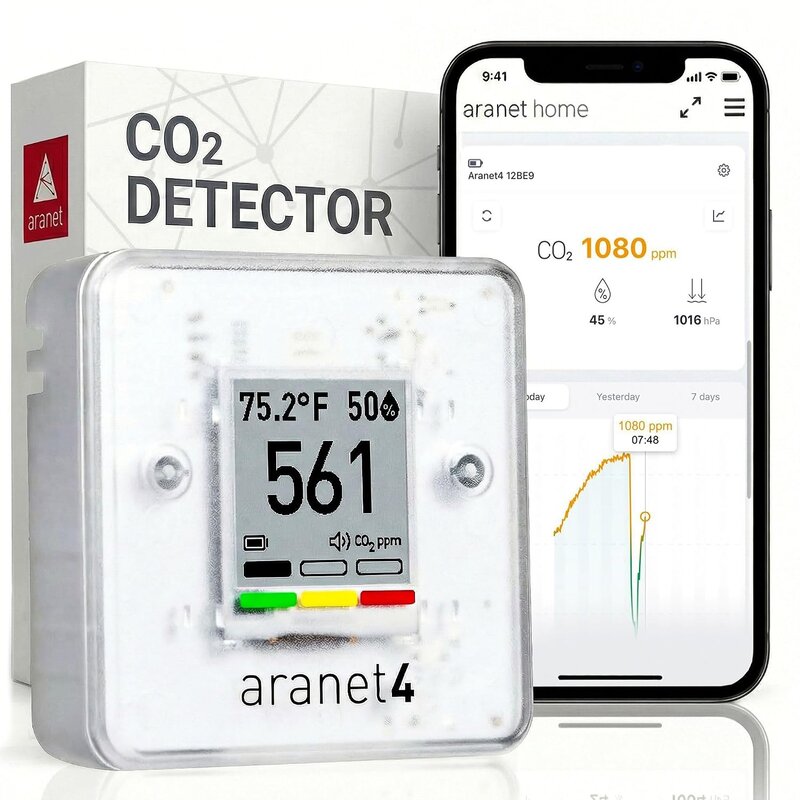
If carbon dioxide is the reading you care about most, the Aranet4 Home is the specialist to buy. It uses a non-dispersive infrared (NDIR) sensor, the same type used in professional instruments, with a published range of 0 to 9,999 ppm and accuracy of plus or minus 30 ppm plus 3 percent of the reading. It also reports temperature, relative humidity and atmospheric pressure.

CO2 is the most useful single indicator of whether a room is getting enough fresh air, which is why the Aranet4 is a favorite for bedrooms, home offices, classrooms and meeting rooms. A rising number is a simple cue to open a window or run ventilation.

The e-ink screen is sharp and readable from across a room, uses almost no power and does not glow at night. With an advertised battery life of up to four years, you can carry it from the bedroom to the office to a hotel room without cables. The Bluetooth app shows history and alerts with no subscription, and the warranty runs two years, extendable to three with registration.

The trade-off is coverage. It does not measure particulate matter, VOCs or radon, so it will not tell you about cooking smoke or wildfire haze. Its Bluetooth connection also means data syncs only when your phone is nearby, rather than continuously to the cloud over Wi-Fi.


Pros
  • NDIR CO2 sensor with published accuracy
  • Also measures temperature, humidity and atmospheric pressure
  • Highly readable, low-power e-ink display
  • Up to four years on batteries
  • Fully portable, no cables needed
  • No subscription for app features
  • Warranty extendable to three years
Cons
  • No particulate, VOC or radon sensing
  • Bluetooth only, no direct Wi-Fi cloud sync
PICK #3
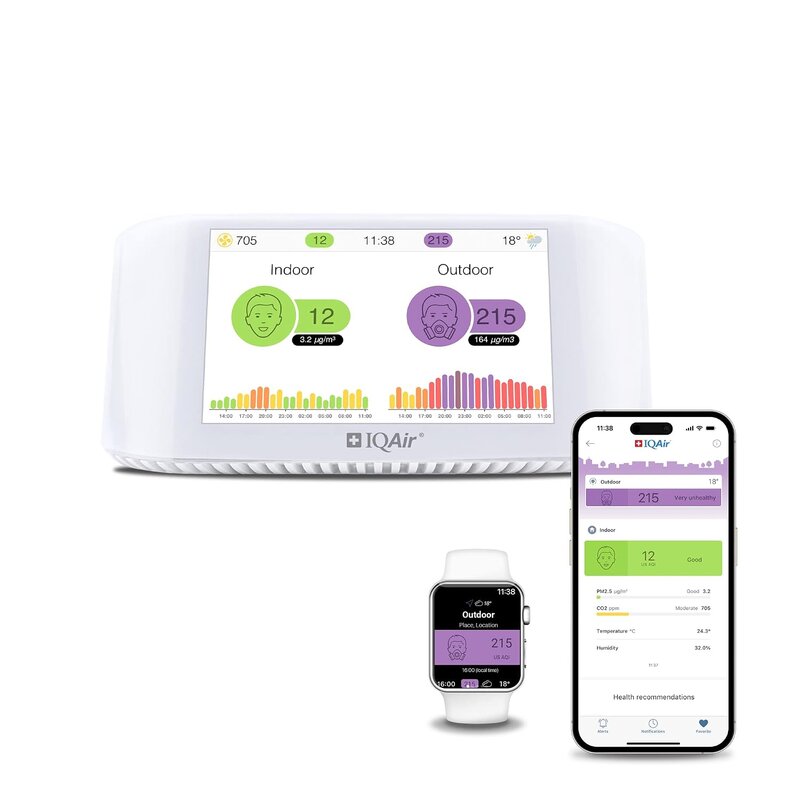
IQAir AirVisual Pro Indoor Air Quality Monitor
Image courtesy of IQAir

IQAir AirVisual Pro Indoor Air Quality Monitor

from IQAir
Rating
8.8 / 10
★★★★☆
Sensor Coverage
80%
Data & App
88%
Display
94%
Placement Flexibility
78%
Value
76%

IQAir runs a major public air quality network, and the IQAir AirVisual Pro brings that perspective indoors. Alongside your indoor PM2.5 and CO2 readings, the companion app shows outdoor air quality from the AirVisual network, so you can decide when to open windows and when to keep them shut, such as during wildfire smoke events.

The 5-inch color display shows current conditions and a 24-hour history directly on the device, useful for households where not everyone wants to install an app. Anyone walking past can see whether the air is improving or getting worse.

Sensor choices are solid: a laser light scattering sensor for PM2.5 covering 0 to 1,000 micrograms per cubic meter, and an NDIR CO2 sensor with automatic baseline calibration covering 400 to 10,000 ppm. It also reports temperature and humidity, supports IFTTT automations over 2.4 GHz Wi-Fi and powers over USB-C. Against the Qingping Gen 2, its edge is the outdoor comparison and bigger screen.

The internal battery lasts up to about four hours, so in practice it is a plug-in device. It does not measure radon, and it is one of the more expensive monitors here. At 7.36 x 3.31 x 3.05 inches it is bulkier than newer rivals, so give it a spot on a shelf or counter near an outlet.


Pros
  • Large, clear 5-inch color display
  • Indoor versus outdoor comparison in the app
  • Laser PM2.5 and NDIR CO2 sensors
  • 24-hour history visible on the device
  • IFTTT support for automations
  • Also reports temperature and humidity
Cons
  • Battery lasts only a few hours away from power
  • No radon sensing
  • Larger and pricier than most competitors
PICK #4
Qingping Air Quality Monitor Gen 2
Image courtesy of Qingping

Qingping Air Quality Monitor Gen 2

from Qingping
Rating
8.6 / 10
★★★★☆
Sensor Coverage
88%
Data & App
80%
Display
92%
Placement Flexibility
80%
Value
86%

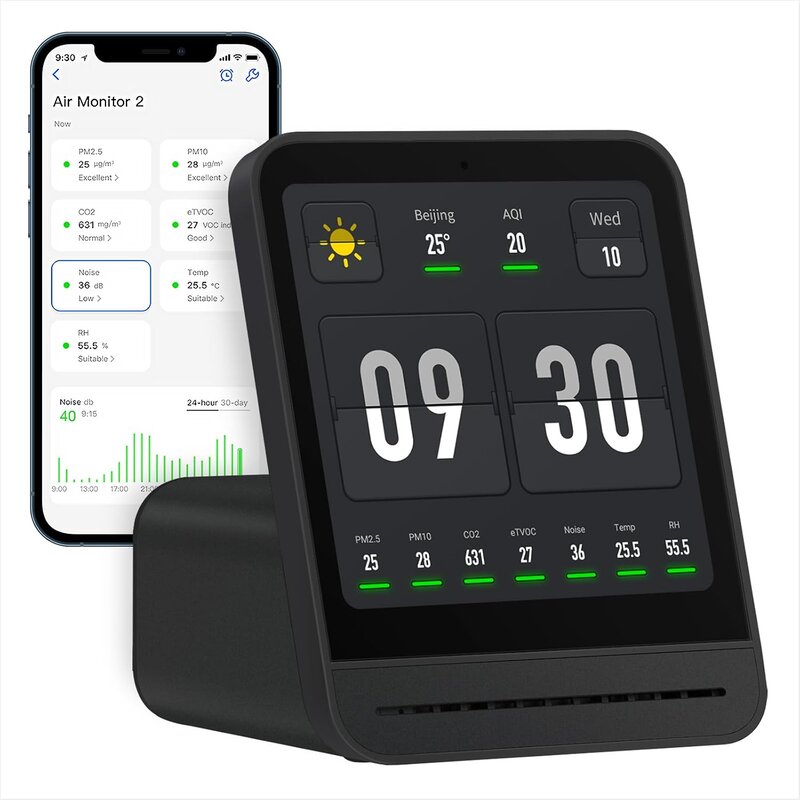
The Qingping Air Monitor Gen 2 packs seven readings into a compact cube with a sharp 4-inch touchscreen: temperature, humidity, CO2, PM2.5, PM10, an estimated TVOC index and noise level. That gives you a broad picture of a room, from stuffiness to cooking particles to how loud things get at night.

The 720 x 720 screen, at 254 PPI, adjusts brightness automatically and doubles as a clock with an alarm, a natural fit for a desk or nightstand. At 74 x 85 x 104 mm and 250 g it takes up little space, and its CO2 reading covers 400 to 9,999 ppm.

Connectivity is flexible: it supports both 2.4 GHz and 5 GHz Wi-Fi, which can make setup easier on modern mesh routers, and the Qingping+ app keeps historical records. A pop-up, replaceable particulate sensor could extend its useful life. Compared with the IQAir AirVisual Pro, it trades a smaller screen and the outdoor comparison for PM10 and noise readings.

The 1,800 mAh battery lasts only about three hours, so it is really a plug-in monitor that you can briefly move. Its VOC reading is an estimate rather than a direct measurement, it does not measure radon, and smart-home integration is narrower than Airthings or Amazon, since the official apps are Qingping+ and Mi Home.


Pros
  • Seven readings including PM10 and noise
  • Crisp 4-inch touchscreen with auto brightness
  • Supports both 2.4 GHz and 5 GHz Wi-Fi
  • Replaceable particulate sensor
  • Compact footprint for desks and nightstands
  • Built-in clock and alarm
Cons
  • Battery lasts only about three hours
  • VOC reading is an estimate
  • No radon measurement
  • Narrower smart-home ecosystem support
PICK #5
Amazon Smart Air Quality Monitor
Image courtesy of Amazon

Amazon Smart Air Quality Monitor

from Amazon
Rating
8.1 / 10
★★★★☆
Sensor Coverage
72%
Data & App
82%
Display
60%
Placement Flexibility
76%
Value
92%

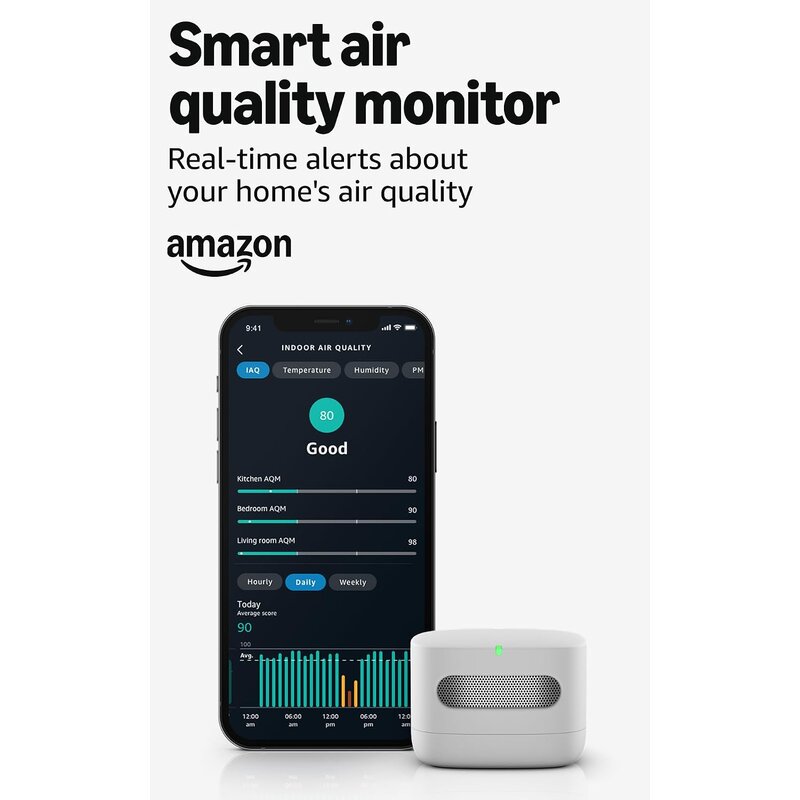
The Amazon Smart Air Quality Monitor is the simplest way to add air quality data to an Alexa home. It tracks particulate matter, VOCs, carbon monoxide, humidity and temperature, and shows an overall status through a colored indicator light, so a quick glance tells you whether conditions are fine or need attention.

Detailed readings live in the Alexa app, and you can have an Echo device announce when air quality drops or build Alexa routines that, for example, turn on a smart plug connected to a fan or purifier. If your home already runs on Alexa, setup is quick.

It is simple enough to place one in several rooms, such as a kitchen, bedroom and home office, and it runs from a 5V, 1A plug-in supply. For many households, a clear signal that the kitchen air has worsened after cooking is all they need, and an Echo announcement means nobody has to check an app.

The limitations are significant. It does not measure CO2, the best indicator of ventilation, or radon. Amazon is explicit that it is not a substitute for a carbon monoxide alarm and is not certified as one, so treat the CO reading as informational and keep a dedicated CO alarm. There is no numeric display on the device, and it needs a constant power connection.


Pros
  • Seamless Alexa integration and routines
  • Five readings including PM2.5 and VOCs
  • Announcements through Echo devices
  • Simple setup through the Alexa app
  • Easy to place in multiple rooms
Cons
  • No CO2 measurement, the best ventilation indicator
  • No radon measurement
  • No numeric display on the device
  • CO reading is informational, not a certified alarm
  • Needs a constant power connection

❓ What Is an Indoor Air Quality Monitor

An indoor air quality monitor is a small electronic device that measures what is in the air of a home or office and shows the readings on a screen, a phone app or both. It turns invisible conditions such as stale air, fine dust and chemical fumes into numbers and color-coded alerts you can act on.

Each monitor combines several sensors. A CO2 sensor, ideally a true NDIR type rather than an estimated reading, shows how well a room is ventilated. A laser particle sensor counts fine particles such as PM2.5 from cooking, candles or outdoor smoke. Many units add VOC, temperature and humidity sensors, and a few premium models also track radon over days and weeks.

Designs range from simple battery-powered displays that sit on a shelf to Wi-Fi models that log history, send notifications and connect to smart-home platforms. Some trigger an air purifier, fan or ventilation system automatically when a reading crosses a threshold you set.

These monitors are used by households who want to know when to open a window or run a purifier, by people working from home in small offices, and by landlords and homeowners checking basements for radon. They inform decisions; they do not clean the air themselves.

⭐ Benefits of Indoor Air Quality Monitor

Things To Consider When Choosing the Best Indoor Air Quality Monitor

What To Avoid When Choosing Indoor Air Quality Monitor

Discover Top Indoor Air Quality Monitor
Owen Carter
Owen Carter – Research Specialist
Owen Carter is a research specialist at CompareLoft. He builds each guide by comparing manufacturer specifications, safety listings, warranty terms and patterns in verified buyer reviews. CompareLoft does not lab-test products; scores are editorial judgments based on that research.