The Reliable Resource for Impartial Product Insights

Best 5 Cellular Trail Cameras of 2026: Scout Smarter From Home

Owen Carter
By Owen Carter – Research Specialist
Owen Carter is a research specialist at CompareLoft. He builds each guide by comparing manufacturer specifications, safety listings, warranty terms and patterns in verified buyer reviews. CompareLoft does not lab-test products; scores are editorial judgments based on that research. How we review
Updated October 2026

A cellular trail camera changes the rhythm of scouting. Instead of walking in to pull an SD card every week and leaving scent all over a stand site, you get photos pushed to your phone within minutes of a buck stepping into frame. That means fewer trips, less pressure on the deer, and a much clearer picture of when animals actually move.

The trouble is that cellular cameras vary far more than their spec sheets suggest. Megapixel numbers are often interpolated, trigger speeds are quoted under ideal conditions, and battery life depends heavily on how many images you transmit and how strong the signal is where you hang the camera. Carrier support matters too: a camera locked to a single network is only useful if that network actually reaches your property.

To build this list, we compared manufacturer specifications, published retailer data, warranty terms and recurring patterns in verified buyer reviews for the cellular models that serious hunters and landowners are buying right now. We did not run our own field trials; scores are editorial judgments based on that documented information and on how each feature set fits real-world use cases.

Every camera here needs a cellular data plan from its manufacturer to send images, so plan costs and app quality are part of the decision. Below you will find our five picks, what each one does best, the trade-offs to know about, and a buying guide that explains which specs genuinely matter when you are choosing a camera for a food plot, a scrape line or a gate.


Our Evaluation Standards


Image and night quality

We looked at stated photo and video resolution, whether resolution is native or interpolated, flash type (no-glow versus low-glow infrared) and published flash range. Night images are where most cellular cameras fall short, so illumination range carried real weight.

Trigger speed and detection

A fast trigger and a long detection range decide whether you get the whole deer or just a tail. We compared rated trigger speed, detection distance, field of view and any unusual coverage features such as rotating lenses.

Network and power

We favored cameras that connect to multiple carriers automatically, offer built-in memory or GPS, and accept external power or solar accessories. Battery configuration and published battery-life claims were weighed against how much each camera transmits.

Ease of use and support

Cellular cameras live or die by their app. We considered setup steps, remote settings changes, on-demand capture and the patterns buyers report about app reliability, along with warranty coverage where it was published.

#1 TOP PICK
Moultrie Edge 2 Pro Cellular Trail Camera
Image courtesy of Moultrie

Moultrie Edge 2 Pro Cellular Trail Camera

from Moultrie
Rating
9.4 / 10
★★★★★
Image Quality
94%
Trigger & Detection
93%
Battery & Power
84%
Ease of Use
90%
Value
86%

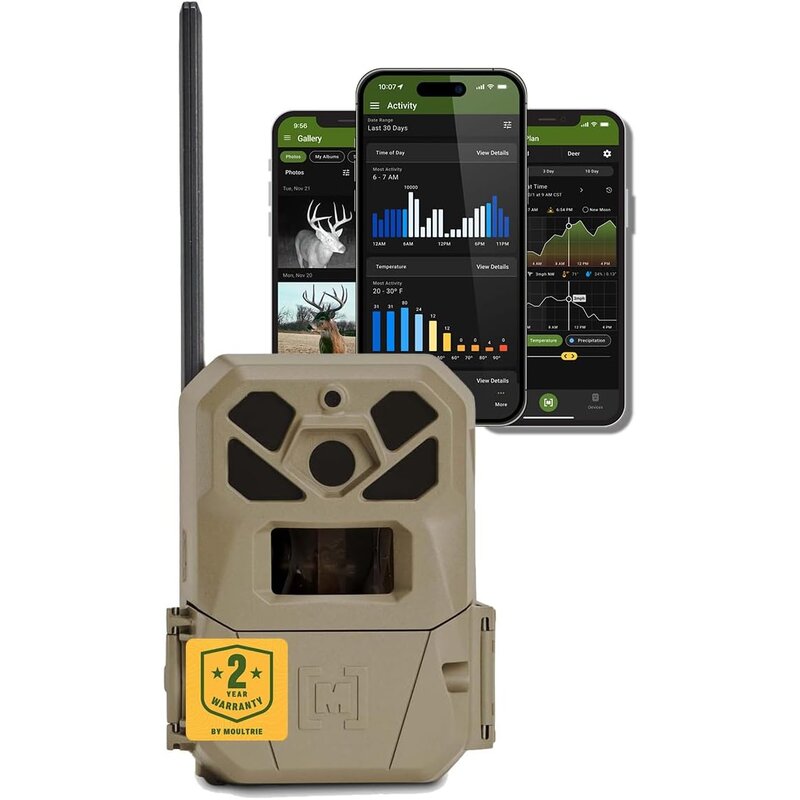
The Moultrie Edge 2 Pro earns our top spot because it gets the fundamentals right at the same time. It pairs a 0.3-second trigger with detection and infrared illumination rated out to 100 feet, plus a 40 MP photo setting. For a cellular camera that has to catch deer moving past a feeder or along a trail, that combination covers the basics most hunters care about. 🦌

Night images get particular attention. Moultrie redesigned the IR array on this generation to spread light more evenly across the frame, which addresses the dark-corners problem on many night images from cheaper cellular cameras. That makes after-dark visitors near the edges of a photo easier to make out, not just the animal standing in the middle. 🌙

Its real advantage is control. Through the Moultrie Mobile app you can request a photo or video on demand, change settings remotely and filter out false triggers, so you rarely need to walk in just to adjust something. Fewer trips to the stand means less human scent and disturbance around a feeder or food plot, which is a common goal with cellular cameras. 📱

Built-in memory removes the SD card from the equation entirely, which is one less thing to forget or fail in cold weather. Buyers frequently mention that auto-connect makes setup simple, because the camera picks the strongest available network on its own rather than requiring a carrier-specific model. Power comes from 8 or 16 AA batteries, with solar and lithium pack accessories sold separately, so you can build the power setup around how long the camera stays out.

Compared with the other picks, it pairs the 0.3-second trigger and 100-foot range of the SPYPOINT Flex G-36 with built-in memory and remote photo and video requests. The Tactacam Reveal X Gen 3.0 is simpler and stronger on battery life, the Stealth Cam Revolver 360 covers wider angles, and the Bushnell CelluCORE Live adds real-time streaming. For the most remote control from a single unit, this is the one to pick.

The trade-off is power appetite. Running 16 AA batteries is the practical choice if you want a full season, and heavy video use will drain them faster, so the solar pack is worth considering for a camera that stays out long term. Some advanced app features depend on the plan tier you choose, and the 50-degree field of view is narrower than some rivals.

Key Specifications
Photo resolution40 MP
Trigger speed0.3 seconds
Detection and IR rangeUp to 100 ft
Field of view50 degrees
Power8 or 16 AA batteries; solar and lithium pack accessories sold separately
StorageBuilt-in memory, no SD card required

Pros
  • Fast 0.3-second trigger
  • Detection and IR range up to 100 ft
  • Redesigned IR array for more even night photos
  • 40 MP photo setting
  • On-demand photos and video from the app
  • Change settings remotely and filter false triggers
  • Built-in memory, no SD card to manage
  • Auto-connects to the strongest available network
  • Accepts 8 or 16 AA batteries plus solar accessories
Cons
  • Battery drain climbs quickly with frequent video
  • Some advanced app features depend on the plan tier you choose
  • 50-degree field of view is narrower than some rivals
Wrap-Up

The Moultrie Edge 2 Pro is the camera for hunters who want the most remote control from a single unit. It pairs a 0.3-second trigger and 100-foot detection range with photos and video you can request from the app, and built-in memory removes the SD card entirely.
PICK #2
TACTACAM Reveal X Gen 3.0 Cellular Trail Camera
Image courtesy of Tactacam

TACTACAM Reveal X Gen 3.0 Cellular Trail Camera

from Tactacam
Rating
9.1 / 10
★★★★★
Image Quality
88%
Trigger & Detection
85%
Battery & Power
92%
Ease of Use
93%
Value
92%

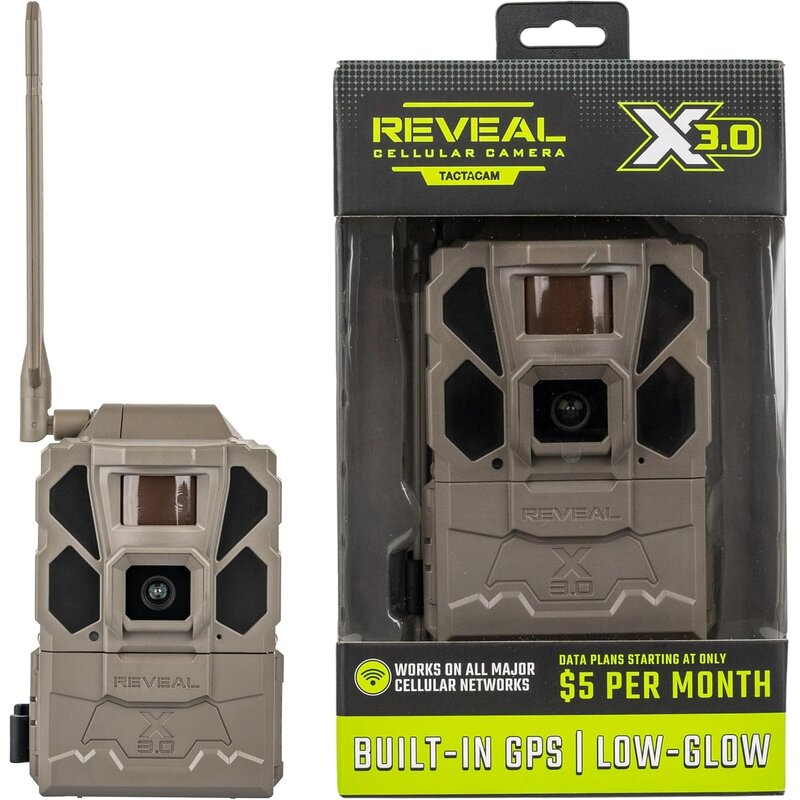
The Tactacam Reveal X Gen 3.0 keeps the simple formula that made the Reveal X line popular while adding the features hunters asked for. It auto-connects to multiple LTE carriers, has GPS built in so the app can place every camera on a map, and stores images on 8 GB of internal memory, so an SD card is optional rather than required.

Its IP66 rating means it is sealed against dust and heavy rain, which suits cameras that hang through a full season. Buyers consistently praise the Reveal app as one of the cleaner and more intuitive in the category, with straightforward species and buck filtering, so sorting a week of images from several stands takes less time.

Battery life is the standout. Tactacam advertises six-plus months on 12 AA batteries, and the 12-volt jack makes it easy to add an external battery or a solar panel. For hunters running several cameras across a property, long runtime, GPS placement and an easy app mean fewer trips to keep every camera going.

Where it gives ground is image detail. The 4K photo figure is interpolated, so daytime images look good on a phone but lack the native detail of a true high-resolution sensor, video tops out at 1080p, and the low-glow flash produces a faint visible glow at night. Retailer measurements also put its detection range shorter than the Moultrie Edge 2 Pro. If you value reliability over maximum image quality, it is the smart buy.


Pros
  • Long advertised battery life of six months or more
  • Multi-carrier auto-connect
  • Built-in GPS places each camera on a map
  • 8 GB internal storage, SD card optional
  • IP66 weather sealing
  • Well-regarded Reveal app with species and buck filtering
  • 12-volt jack for solar or external batteries
Cons
  • 4K photo figure is interpolated and video tops out at 1080p
  • Low-glow flash is visible at night, and detection range is shorter than the Moultrie Edge 2 Pro
PICK #3
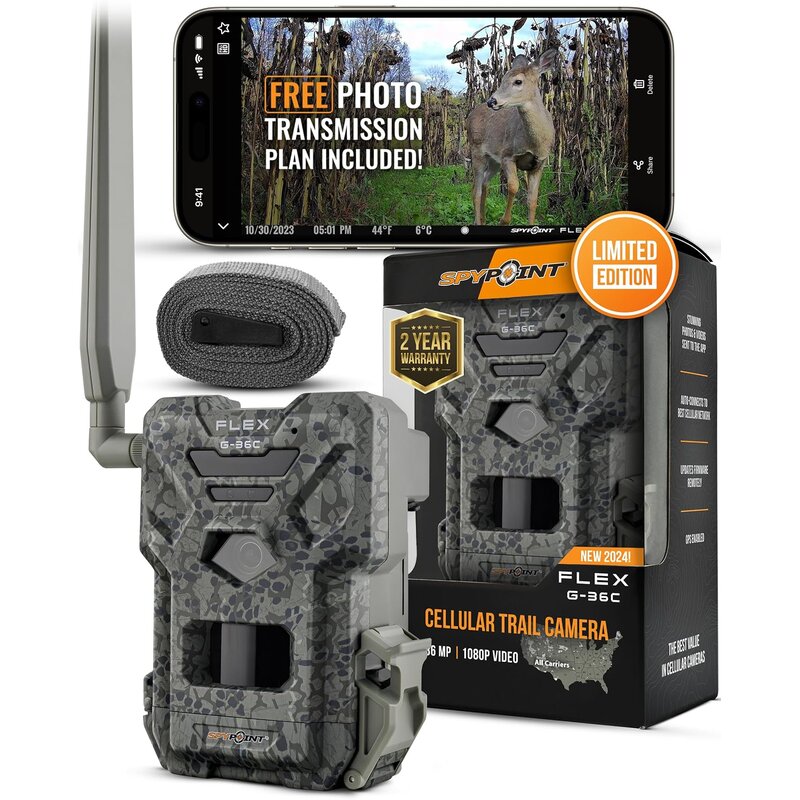
SPYPOINT Flex G-36 Cellular Trail Camera
Image courtesy of SPYPOINT

SPYPOINT Flex G-36 Cellular Trail Camera

from SPYPOINT
Rating
8.8 / 10
★★★★☆
Image Quality
90%
Trigger & Detection
90%
Battery & Power
82%
Ease of Use
86%
Value
88%

The SPYPOINT Flex G-36 is built around flexibility of connection. SPYPOINT says it works on all major US cellular networks, now including US Cellular, and it automatically connects to whichever offers the best coverage at your stand. On rural ground where one carrier fades in and out, that can be the difference between getting images and staring at an empty app.

On paper it is quick and capable: a 0.3-second trigger, 100-foot flash and detection range, 36 MP photos and 1080p video with sound. GPS is enabled, and capture modes cover photo, video, Time-Lapse and Time-Lapse+, so one camera can handle both trail monitoring and watching an entire field edge.

Constant Capture lets the camera keep shooting while it uploads, so you are less likely to miss a second animal walking through behind the first. Compared with the Moultrie Edge 2 Pro, it matches the trigger speed and detection range but uses a microSD card instead of built-in memory, and the Stealth Cam Revolver 360 is restricted to Verizon and AT&T.

Buyer feedback on the Flex series is positive about connectivity but more mixed on battery life, especially when transmitting full-resolution images or video, so plan on lithium batteries or a solar accessory for remote sets. The microSD card is one more item to manage. For hunters fighting weak or inconsistent signal, though, it is an excellent choice.


Pros
  • Connects to all major US networks automatically
  • Quick 0.3-second trigger
  • 100-ft flash and detection range
  • Video with sound
  • Keeps capturing while transmitting
  • Time-Lapse+ mode for scanning fields
Cons
  • Battery life drops noticeably with video and full-size uploads
  • Lithium batteries or a solar accessory recommended for remote sets
  • Requires a microSD card for storage
PICK #4
Stealth Cam Revolver 360 Cellular Trail Camera
Image courtesy of Stealth Cam

Stealth Cam Revolver 360 Cellular Trail Camera

from Stealth Cam
Rating
8.5 / 10
★★★★☆
Image Quality
85%
Trigger & Detection
84%
Battery & Power
80%
Ease of Use
79%
Value
80%

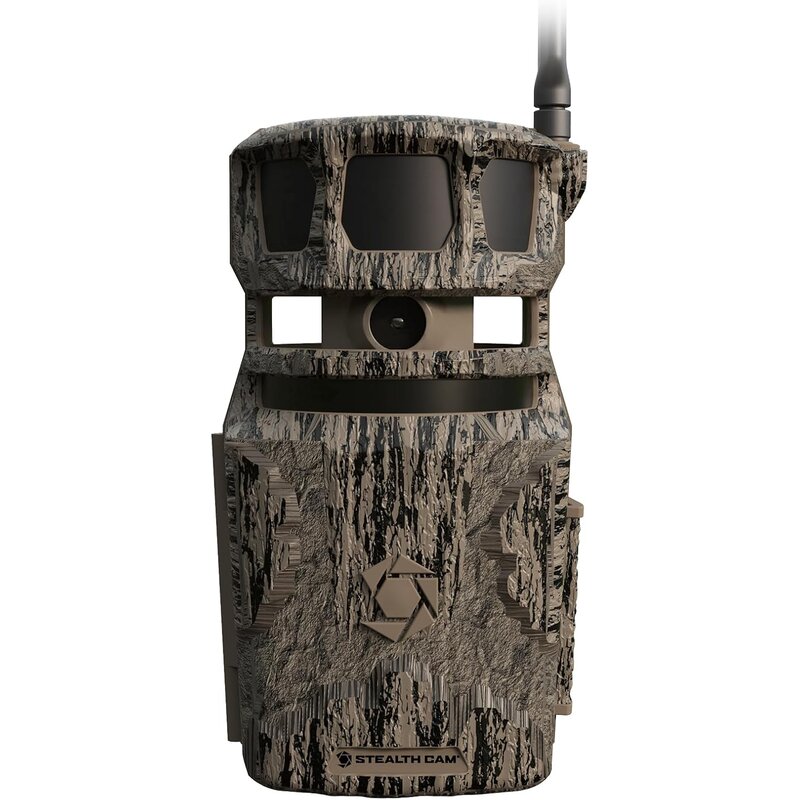
The Stealth Cam Revolver 360 solves a problem no fixed camera can: covering several trails, a food plot and a field edge from one tree. A silent motor rotates the lens toward wherever motion is detected, and you can set it to watch a single zone, a 180-degree arc or the full 360 degrees.

For open fields, trail intersections or property surveillance, one Revolver can replace multiple fixed cameras, each of which would need its own batteries and plan. Its 80-foot detection range is respectable, and the no-glow infrared flash suits security use around gates or equipment because it gives off no visible red glow.

It accepts SD cards up to 128 GB and runs on 16 AA batteries with a 12-volt jack for an external battery or solar setup. Photos are 36 MP interpolated with 1080p video, while the Moultrie Edge 2 Pro, SPYPOINT Flex G-36 and Bushnell CelluCORE Live all list 0.3-second triggers.

The rotating design trades speed for coverage. Retailer measurements show slower trigger and recovery times than our top three, so a fast-moving deer may be past the frame before the lens settles. It is also bulkier and draws more power than a fixed unit, connects only on Verizon and AT&T, and takes more thought to set up because you are configuring zones rather than just aiming.


Pros
  • Rotating lens covers up to 360 degrees
  • Selectable single, 180-degree or 360-degree zones
  • One unit can replace several fixed cameras
  • No-glow flash suits security use
  • Accepts SD cards up to 128 GB
  • 12-volt jack for external power
Cons
  • Slower trigger and recovery than fixed cameras
  • Bulky and power-hungry on 16 AA batteries
  • Connects only on Verizon and AT&T networks
  • Zone setup takes more thought than aiming a fixed camera
PICK #5
Bushnell CelluCORE Live Cellular Trail Camera
Image courtesy of Bushnell

Bushnell CelluCORE Live Cellular Trail Camera

from Bushnell
Rating
8.2 / 10
★★★★☆
Image Quality
84%
Trigger & Detection
86%
Battery & Power
74%
Ease of Use
82%
Value
78%

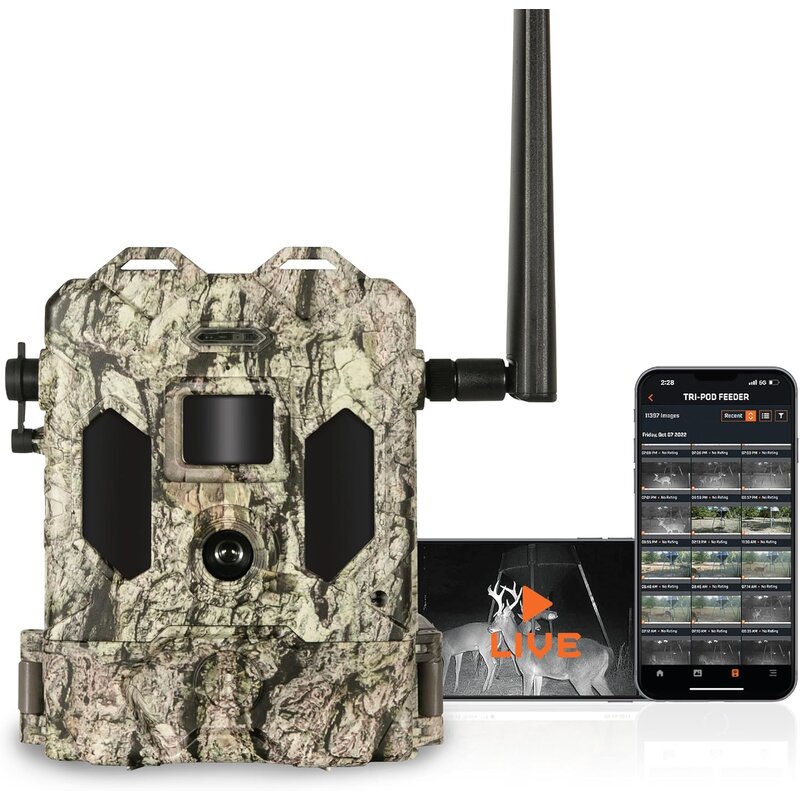
The Bushnell CelluCORE Live stands out for one feature: real-time streaming. Instead of waiting for the next motion trigger, you can check in on a feeder, a gate or a field edge live from your phone, which helps when you want to confirm deer are on a plot before an evening sit or keep an eye on property.

The core camera is solid. A 0.3-second trigger, 32 MP stills and 1080p HD video put it in line with mainstream rivals, and dual SIM connectivity gives it two chances to find a usable network instead of depending on one carrier. Bushnell also highlights compatibility with the onX Hunt mapping app.

It is the only pick here built around live viewing. The Moultrie Edge 2 Pro offers remote photo and video requests with built-in memory, the Tactacam Reveal X Gen 3.0 focuses on long battery life, and the SPYPOINT Flex G-36 connects to every major network; those offer better all-around value if streaming is not your priority.

The weaker points are power and documentation. The retailer listing we read did not publish a battery-life figure or flash range, and live streaming uses more power and data than occasional uploads, so expect more battery changes or external power if you check in often. Buyers also report that stream quality depends heavily on signal, so it suits stands with reliable coverage.


Pros
  • Real-time live image streaming
  • Dual SIM connectivity for better coverage odds
  • Quick 0.3-second trigger
  • 32 MP photos and 1080p video
  • Works with the onX Hunt app
Cons
  • Live streaming uses more power than occasional uploads
  • Streaming also increases data use
  • Battery life figure not published in the listing
  • Flash range not published in the listing
  • Stream quality depends on strong signal

❓ What Is a Cellular Trail Camera

A cellular trail camera is a weatherproof, battery-powered camera that mounts to a tree or post, captures photos or video when motion is detected, and sends those images over a mobile network to an app on your phone. You see what walked past without walking in to pull a memory card.

Each camera pairs a passive infrared motion sensor with a camera and an infrared flash for night shots. When an animal or person crosses the detection zone, the camera triggers, saves the image and uploads a copy through a built-in cellular modem. A data plan from the camera maker or a carrier is required, and coverage at the mounting spot decides whether images arrive reliably.

Models differ in image quality, trigger speed, battery type and night flash. No-glow infrared flashes are hard for animals and people to notice, while low-glow flashes reach farther. Many cameras support solar panels or external batteries, and apps add remote settings, species tagging and map views across several cameras.

Hunters use cellular trail cameras to pattern deer and other game without disturbing an area. Landowners, farmers and cabin owners also use them to watch gates, remote property and equipment. Several cameras can be managed together from a single app account.

⭐ Benefits of Cellular Trail Camera

Things To Consider When Choosing the Best Cellular Trail Camera

What To Avoid When Choosing Cellular Trail Camera

Discover Top Cellular Trail Camera
Owen Carter
Owen Carter – Research Specialist
Owen Carter is a research specialist at CompareLoft. He builds each guide by comparing manufacturer specifications, safety listings, warranty terms and patterns in verified buyer reviews. CompareLoft does not lab-test products; scores are editorial judgments based on that research.