The Reliable Resource for Impartial Product Insights

Best 5 Cutting Boards of 2026: Teak, Maple, Plastic and Composite Picks

Owen Carter
By Owen Carter – Research Specialist
Owen Carter is a research specialist at CompareLoft. He builds each guide by comparing manufacturer specifications, safety listings, warranty terms and patterns in verified buyer reviews. CompareLoft does not lab-test products; scores are editorial judgments based on that research. How we review
Updated October 2026

A cutting board is the one kitchen tool that touches almost everything you cook, and it quietly affects how your knives perform, how long prep takes and how much cleanup you face afterward. A board that is too small crowds your work, one that slides around is a hazard, and one that is too hard can dull a good chef's knife faster than you would expect.

There is no single perfect material. Edge-grain hardwoods like teak and maple are durable and comfortable to cut on. End-grain boards are gentler on knife edges but need more upkeep. Polypropylene and paper composite boards can go in the dishwasher, which many cooks prefer for raw meat and poultry. Many well-equipped kitchens end up with one wood board for everyday prep and one dishwasher-safe board for proteins.

For this guide, we compared manufacturer specifications, materials, care instructions, warranty terms and recurring patterns in verified buyer reviews for widely sold boards on Amazon. We did not run our own knife or cleaning trials, so every dimension and material detail below comes from the brand or an authorized retailer, and our scores are editorial judgments of how those specs serve home cooks.

Below you will find five boards in five different materials and styles, a side-by-side comparison, a buying guide that explains grain types and sizing, and answers to the questions shoppers ask most.


Our Evaluation Standards


Material and grain

We weighed how each material treats knife edges and how it holds up to years of chopping, from edge-grain teak and maple to end-grain walnut, polypropylene and wood-fiber composite.

Usable work surface

We looked at listed dimensions and thickness, whether the board is reversible, and how much flat space is left once a juice groove or compartments are factored in.

Care and cleanup

Dishwasher safety, oiling schedules and the manufacturer's own care instructions all mattered, because a board you dread cleaning tends to get neglected.

Stability and handling

Non-slip feet, hand grips, weight and overall build affected scores, since a board that shifts while you cut is both frustrating and unsafe.

#1 TOP PICK
Rating
9.4 / 10
★★★★★
Knife-Friendliness
92%
Durability
94%
Easy Care
80%
Work Surface
97%
Value
88%

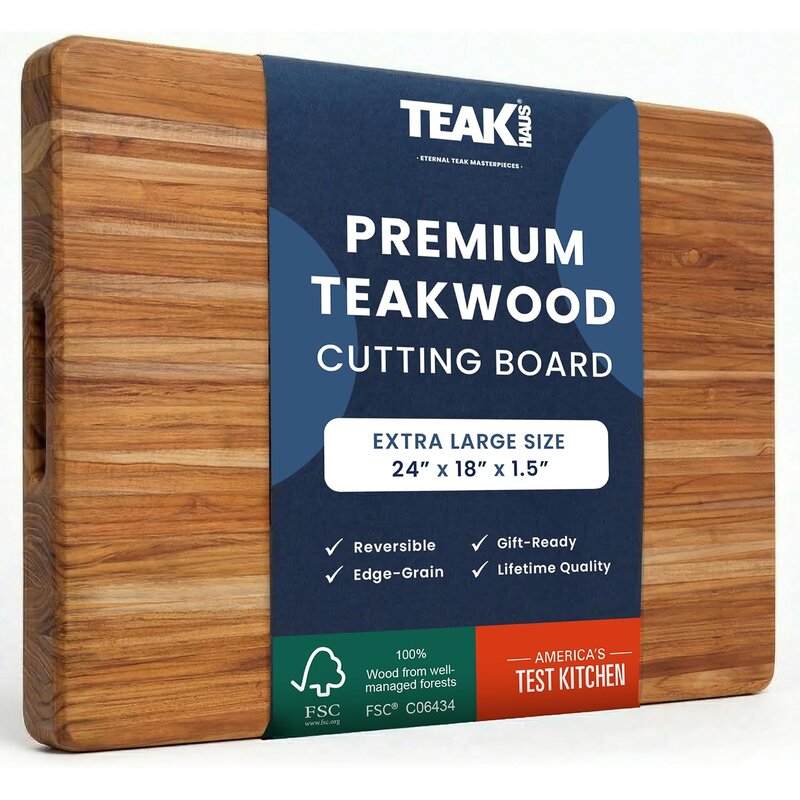
The Teakhaus 107 earns our top spot because it gives home cooks a huge, stable work surface in a wood that is notably easy to live with. At 24 by 18 inches and 1.5 inches thick, there is room to break down a chicken, chop a pile of vegetables and still push prepped ingredients aside before they go into the pan. 🍳

The wood itself does a lot of the work. Teak's naturally high oil content helps the board resist water and staining, and many owners note it needs oiling less often than maple. That makes it a forgiving choice for cooks who want a wood board without a strict maintenance routine, although, like any wood, it still appreciates a coat of oil now and then. ✨

It is an edge-grain board, which means the wood strips run lengthwise with the long sides facing up. That construction is durable and less prone to cracking than many end-grain designs, while still being comfortable on knife edges. The 1.5-inch thickness adds to the stable, planted feel when you are chopping through dense vegetables or breaking down a bird.

Both faces are usable, so you can keep one side for raw ingredients and the other for bread or produce, and inset hand grips make the board easier to lift and turn. Teakhaus uses 100% FSC-certified teak. For a household that cooks most nights, it can stay on the counter as the main prep station rather than coming out only for big jobs. 🏠

The 107 has no juice groove, which maximizes flat cutting space; if you carve a lot of roasts, Teakhaus sells the 108 with a groove. Compared with the John Boos R-Board, it is larger and needs less frequent oiling, while the Sonder Alfred offers gentler end grain and the OXO and Epicurean boards add dishwasher-safe convenience at a much lower weight. That leaves the 107 as the pick for cooks who value sheer cutting room above all else.

The main drawback is size. At about 14.2 pounds, it is heavy to carry to the sink, and it will not fit in many smaller kitchens or standard sinks. Like any wood board, it must be hand washed and dried standing up, never soaked. If you have the counter space, though, it is a board that can serve as your primary prep station for years.

Key Specifications
Dimensions24 x 18 x 1.5 in
MaterialTeak, edge grain
Sourcing100% FSC certified teak
DesignReversible, inset hand grips
Juice grooveNone (see Teakhaus 108 for a grooved version)
WeightAbout 14.2 lb

Pros
  • Large 24 x 18 in work surface
  • Thick 1.5 in board feels stable under heavy chopping
  • Teak's natural oils help resist water and staining
  • Many owners find it needs oiling less often than maple
  • Edge-grain build is durable and less prone to cracking than many end-grain boards
  • Comfortable on knife edges
  • Reversible with inset hand grips
  • 100% FSC-certified teak
  • No groove means maximum flat cutting space, with a grooved sibling (108) available
Cons
  • Heavy at about 14 lb
  • Too large for small kitchens and many sinks
  • Hand wash only
Wrap-Up

The Teakhaus 107 is the best fit for cooks who want a large, durable everyday surface. Its 24 x 18 inch edge-grain teak board is gentle on knives, teak's natural oils help resist water and staining, and the reversible design adds inset hand grips and FSC-certified sourcing.
PICK #2
John Boos R-Board Reversible Maple Cutting Board, 20 x 15 x 1.5 in
Image courtesy of John Boos

John Boos R-Board Reversible Maple Cutting Board, 20 x 15 x 1.5 in

from John Boos
Rating
9.2 / 10
★★★★★
Knife-Friendliness
90%
Durability
93%
Easy Care
70%
Work Surface
88%
Value
86%

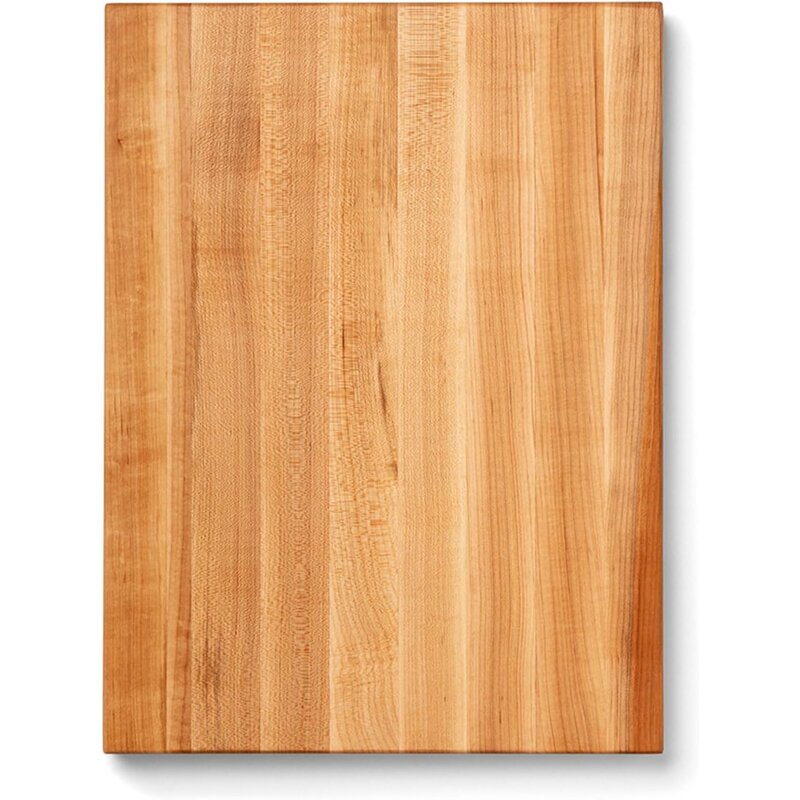
John Boos is one of the best-known names in American butcher blocks, and the John Boos R-Board is the maple board many cooks picture when they think of a serious cutting surface. The 20 by 15 inch size hits a sweet spot: big enough for real prep work, small enough to fit on most counters and carry to the sink.

At 1.5 inches thick it feels solid and stays put under heavy chopping. It is built from northern hard rock maple in edge-grain construction, a dense hardwood that has been a butcher-block standard for generations, made in the USA and pre-coated with Boos board cream containing beeswax, so it is ready to use out of the box.

It is reversible, so one side can handle onions and garlic and the other fruit or bread, and recessed side grips make it easier to flip. Compared with the Teakhaus 107, it is smaller and easier to move but needs oiling more often, while the Sonder Alfred is gentler on knives and the OXO and Epicurean boards are dishwasher safe.

Maple asks more of you than teak. Boos advises oiling regularly and never using the dishwasher or letting the board soak, and owner reviews mention that skipping oil leads to dryness and eventual cracking. The warranty is one year, shorter than you might expect from a premium board. Treat it well and it is the classic maple choice in a versatile middle size.


Pros
  • Proven edge-grain northern hard rock maple
  • Versatile 20 x 15 in size fits most counters
  • 1.5 in thickness stays put under heavy chopping
  • Reversible to keep strong flavors separate
  • Recessed side grips
  • Arrives pre-finished with Boos board cream with beeswax
  • Made in the USA
Cons
  • Needs regular oiling and is never dishwasher safe
  • One-year limited warranty
PICK #3
OXO Good Grips Carving & Cutting Board
Image courtesy of OXO

OXO Good Grips Carving & Cutting Board

from OXO
Rating
8.9 / 10
★★★★☆
Knife-Friendliness
80%
Durability
78%
Easy Care
96%
Work Surface
86%
Value
95%

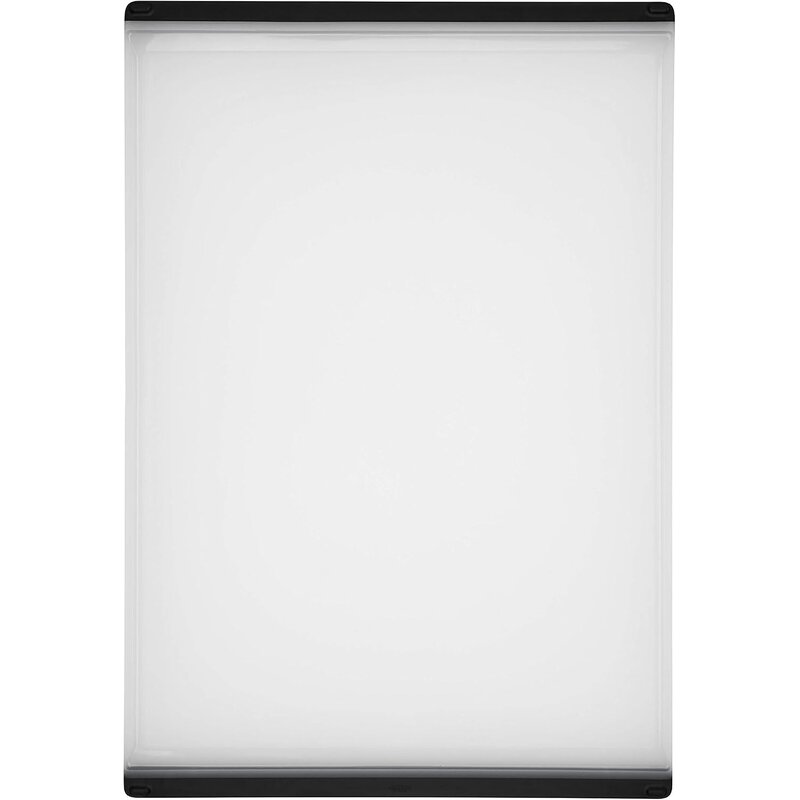
For raw meat, poultry and fish, many cooks prefer a board that can go straight into the dishwasher, and the OXO Good Grips Carving & Cutting Board is one of the most practical options. At about 21.1 by 14.5 inches it offers nearly as much room as the Boos board at a fraction of the weight.

It pairs naturally with a wood board kept for produce and bread. The polypropylene surface is non-porous, so it does not absorb odors the way some woods can, and it can be cleaned at high temperature in the dishwasher after cutting fish, onions or garlic.

One side has a wrap-around juice groove with easy-pour corners for roasts and juicy tomatoes; the other is flat for chopping. Non-slip feet keep it from skating across the counter. Compared with the Epicurean All-In-One, it is larger and softer under the knife, and like the Epicurean it needs no oiling at all.

Plastic wears differently than hardwood. Knife marks accumulate, the surface can turn fuzzy or stained from turmeric and beets, and owner reviews note it may need replacing after a few years of heavy use. Polypropylene is also less forgiving than teak on very thin Japanese blades. For effortless cleanup and raw-protein prep, though, it is a practical choice.


Pros
  • Dishwasher safe for easy cleanup
  • Large 21 x 14.5 in surface at a low weight
  • Wrap-around juice groove with pour corners
  • Non-slip feet
  • Flat reverse side for chopping
  • Non-porous surface resists odors
Cons
  • Shows knife marks and stains over time
  • Will likely need replacing sooner than wood
  • Less forgiving than teak on very thin Japanese blades
PICK #4
Rating
8.7 / 10
★★★★☆
Knife-Friendliness
70%
Durability
90%
Easy Care
95%
Work Surface
78%
Value
92%

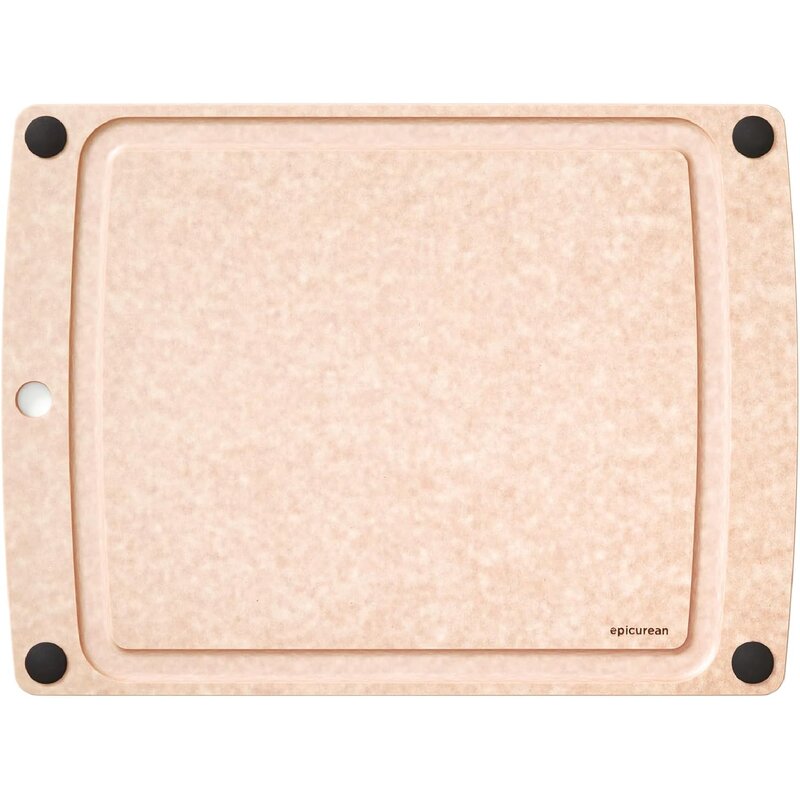
Epicurean boards sit between wood and plastic. The Epicurean All-In-One is made in the USA from Richlite, a wood-fiber composite pressed with resin into a dense, non-porous sheet. The result is a board only a quarter-inch thick that can go in the dishwasher, will not warp the way a thin wood board might, and is heat resistant up to 350°F.

That heat resistance lets it double as a trivet for a hot pan. The All-In-One version adds the two features the classic Kitchen Series lacks, non-slip feet and a juice groove, which matters because thin composite boards tend to slide on smooth countertops.

At 17.5 by 13 inches it handles most weeknight prep and stores upright in a cabinet slot or beside the dish rack, which suits apartment kitchens and renters. Compared with the OXO board it is smaller and thinner, and against the wood boards it gives up heft and knife-friendliness for low-maintenance care.

The trade-off is feel. Composite is harder than wood, so cutting on it is noisier and less forgiving on knife edges, and frequent users may need to hone more often. The thin profile also lacks the heft of a butcher block for heavy chopping. If low maintenance is your top priority, it is one of the most low-fuss boards on this list.


Pros
  • Dishwasher safe and non-porous
  • Heat resistant up to 350°F
  • Thin and light for easy storage
  • Non-slip feet and juice groove
  • Resists warping
  • Made in the USA
Cons
  • Harder surface is less gentle on knife edges
  • Noisier to cut on than wood
  • Thin profile lacks heft for heavy chopping
  • Smaller cutting area than the OXO board
PICK #5
Sonder Los Angeles Alfred End Grain Walnut Cutting Board, 17 x 13 x 1.5 in
Image courtesy of Sonder Los Angeles

Sonder Los Angeles Alfred End Grain Walnut Cutting Board, 17 x 13 x 1.5 in

from Sonder Los Angeles
Rating
8.4 / 10
★★★★☆
Knife-Friendliness
96%
Durability
86%
Easy Care
66%
Work Surface
80%
Value
78%

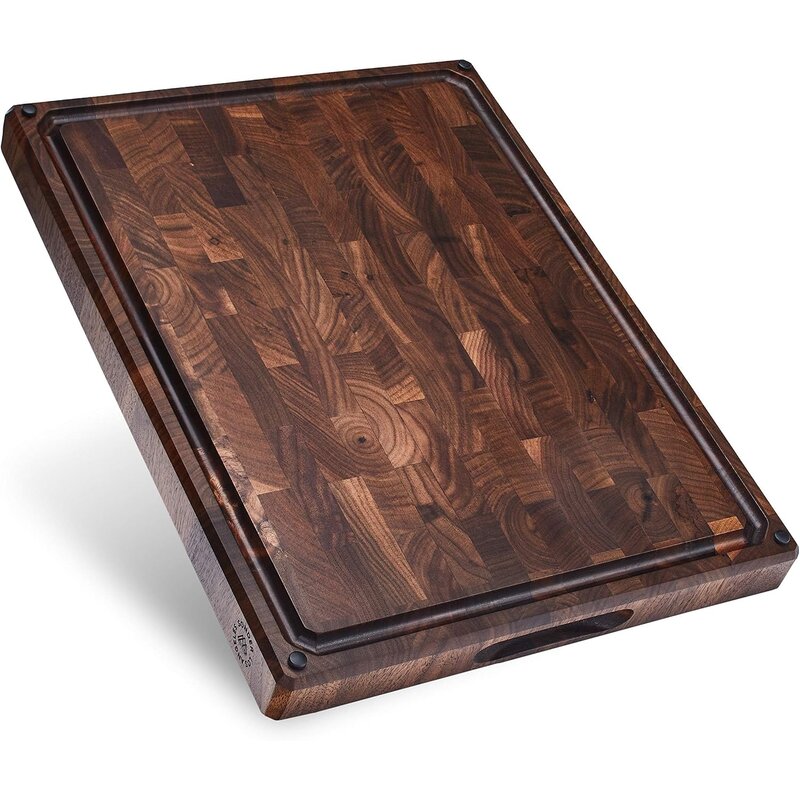
End-grain boards are built from short blocks of wood set on end, so your knife slips between wood fibers rather than slicing across them. That makes end grain the most forgiving surface for fine edges, and the Sonder Los Angeles Alfred is one of the most popular end-grain boards on Amazon, made in the USA from American black walnut.

Walnut is slightly softer than maple with a rich, dark color, which suits cooks who want to protect premium knives. At 17 by 13 by 1.5 inches and 7.5 pounds, it is manageable for daily use while still feeling sturdy on the counter.

A juice groove holding about 3.5 ounces runs along one face, three built-in compartments let you sort ingredients or serve cheese and crackers, removable rubber feet work on both sides, and finger grips help you lift it. Compared with the Teakhaus and Boos boards it is the gentlest surface on knives here, and unlike the OXO and Epicurean it doubles as a serving board.

End grain comes with more upkeep. Sonder calls for hand washing with mild soap, no dishwasher or soaking, and oiling every two to three weeks. The compartments also take up surface area, so usable cutting space is smaller than the dimensions suggest. If knife care and presentation matter most it is a beautiful board; for low maintenance, choose one of the picks above.


Pros
  • End-grain walnut is the gentlest surface here on knives
  • Juice groove and three serving compartments
  • Removable non-slip feet on both sides
  • Made in the USA
  • Attractive enough for serving
Cons
  • Needs oiling every two to three weeks
  • Compartments reduce usable cutting area
  • Hand wash only with mild soap
  • No dishwasher or soaking
  • More upkeep than the edge-grain and dishwasher-safe picks

❓ What Is a Cutting Board

A cutting board is the flat work surface you chop, slice and dice on in the kitchen. It protects countertops, gives knives a surface that will not dull them too quickly, and keeps prep work contained in one place that can be cleaned afterward.

Boards are made from several materials. Hardwoods such as maple, walnut and teak are gentle on knife edges, look good on the counter and last for years with occasional oiling. Plastic boards are light, inexpensive and dishwasher-safe, which makes them popular for raw meat. Composite boards blend wood fibers and resin for a thin, durable surface that also goes in the dishwasher, while bamboo is hard and light but tougher on blades.

Construction matters as well. End-grain boards show the ends of the wood fibers and let knife edges slip between them, so they hide cut marks and are kind to blades. Edge-grain boards are simpler and more affordable. Useful features include juice grooves, non-slip feet, handles and reversible sides.

Home cooks often keep more than one board: a large wood board for vegetables and bread, and a plastic or composite one for raw meat and fish. Professional kitchens use color-coded plastic boards to separate food types.

⭐ Benefits of Cutting Board

Things To Consider When Choosing the Best Cutting Board

What To Avoid When Choosing Cutting Board

Discover Top Cutting Board
Owen Carter
Owen Carter – Research Specialist
Owen Carter is a research specialist at CompareLoft. He builds each guide by comparing manufacturer specifications, safety listings, warranty terms and patterns in verified buyer reviews. CompareLoft does not lab-test products; scores are editorial judgments based on that research.