The Reliable Resource for Impartial Product Insights

Best 5 Laptop Docking Stations of 2026: Thunderbolt and USB-C Docks

Owen Carter
By Owen Carter – Research Specialist
Owen Carter is a research specialist at CompareLoft. He builds each guide by comparing manufacturer specifications, safety listings, warranty terms and patterns in verified buyer reviews. CompareLoft does not lab-test products; scores are editorial judgments based on that research. How we review
Updated October 2026

Modern laptops are thin, light and frustratingly short on ports. A good docking station fixes that with a single cable: plug it in and your laptop charges, connects to one or more monitors, joins a wired network and picks up your keyboard, mouse, webcam and drives all at once. Unplug it and you are ready to walk to a meeting.

The hard part is that docks look similar but behave very differently depending on your computer. Thunderbolt 4 and USB4 docks offer the most bandwidth and the most consistent experience on supported laptops. USB-C docks cost less and work with a wider range of machines, but the number of monitors they can drive often depends on your laptop's graphics and operating system. Some docks use DisplayLink software to add extra displays, which helps with Macs that otherwise support only one external screen.

To pick our five recommendations, we compared manufacturer specifications for ports, display support, laptop charging wattage, operating system compatibility and warranty, along with frequent themes in verified buyer reviews. We did not perform hands-on lab testing; the scores are editorial judgments based on that published information and how well each dock fits common setups.

Below you will find our rankings, a comparison table, a buying guide focused on avoiding compatibility surprises, and answers to the questions shoppers ask most.


Our Evaluation Standards


Display support for your laptop

We checked how many monitors each dock supports, at what resolutions and refresh rates, and the conditions attached, such as Apple silicon limits or DisplayLink software requirements.

Laptop charging power

A dock should deliver enough wattage to keep your laptop charging under load. We compared upstream power delivery against what typical 13- to 16-inch laptops need.

Port selection and speed

We counted ports and noted their speeds, including Thunderbolt downstream ports, 10Gbps USB, Ethernet speed and SD card readers.

Compatibility and support

Docks that work smoothly across Mac, Windows and ChromeOS, and that come with longer warranties, scored higher for households and offices with mixed hardware.

#1 TOP PICK
CalDigit TS4 Thunderbolt 4 Dock
Image courtesy of CalDigit

CalDigit TS4 Thunderbolt 4 Dock

from CalDigit
Rating
9.5 / 10
★★★★★
Port Selection
98%
Display Support
90%
Laptop Charging
96%
Compatibility
92%
Value
82%

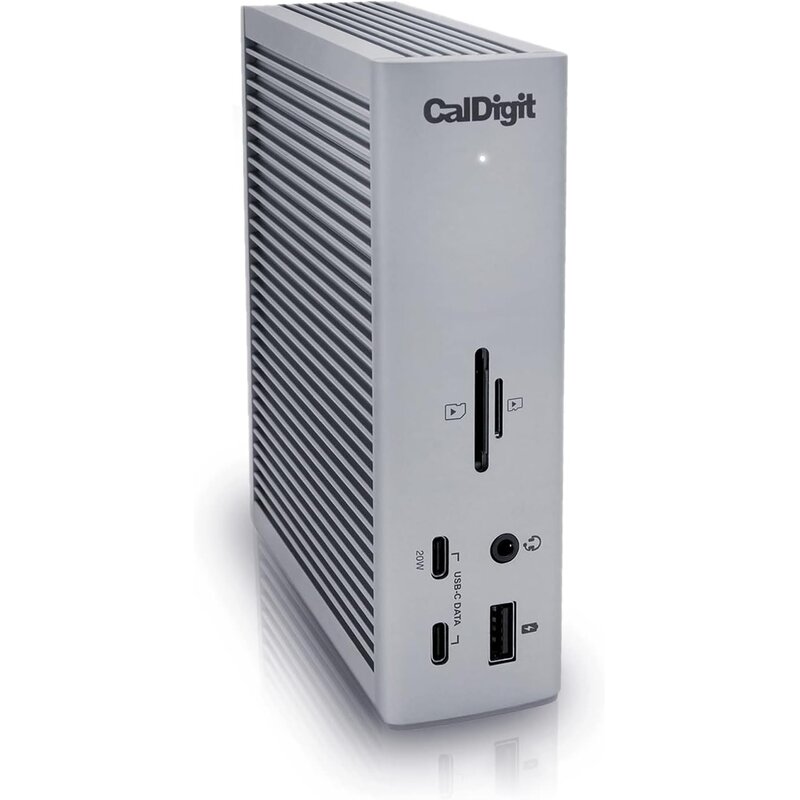
The CalDigit TS4 takes our top spot as the dock to buy if you want one box that handles nearly anything you plug into it for years. It offers 18 ports, including two downstream Thunderbolt 4 ports, three 10Gb/s USB-C ports, five 10Gb/s USB-A ports and a DisplayPort 1.4 output. 💻

The rest of the panel covers UHS-II SD and microSD readers, front and rear audio jacks and 2.5 Gigabit Ethernet. Few docks match that combination of quantity and speed, and with 10Gb/s USB across the board, even the USB-A ports keep up with fast external drives. In daily use, one cable connects a laptop to monitors, drives, a wired network, a webcam, a card reader and speakers at once.

For photographers, video editors and anyone with a busy desk, that removes the usual tangle of adapters and hubs. Charging is generous at up to 98W through the host connection, enough for most large laptops under heavy load, so the same cable that carries data also keeps the battery topped up through a long workday. That figure is higher than the Kensington's 90W and the Anker's 85W. ⚡

Display support depends on your computer. CalDigit lists dual 6K at 60Hz on Apple M-series Pro and Max chips, dual 4K at 60Hz on Intel Macs and Windows, and a single 8K option on supported Windows machines. Base M1 Macs support only one external display, a laptop restriction rather than a dock flaw, so check your own laptop's display limits before planning a multi-monitor desk. It ships with a 0.8-meter Thunderbolt 4 cable and can stand vertically or lie flat.

Compared with the Kensington SD5700T, the TS4 offers more ports, faster Ethernet and slightly higher charging, while the Kensington adds a third downstream Thunderbolt port and a longer warranty. The Plugable and Dell docks focus on multi-monitor setups that need DisplayLink software, while the TS4 drives displays natively over Thunderbolt, and the Anker 575 is the value choice. With 18 ports to the Kensington's 11, the TS4 is the most complete Thunderbolt dock here.

The negatives are cost and the fact that the extra Thunderbolt features only shine on Thunderbolt or USB4 laptops. The 2.5GbE port, for example, requires a Thunderbolt host, and the two-year warranty is shorter than Kensington's three years. If you just need a few ports and one monitor, a cheaper USB-C dock will do the job. 🖥️

Key Specifications
Total ports18
Laptop chargingUp to 98W
Thunderbolt3x Thunderbolt 4 (40Gb/s), incl. host port
USB3x USB-C and 5x USB-A, all 10Gb/s
Networking2.5 Gigabit Ethernet
Warranty2 years

Pros
  • 18 ports with 10Gb/s USB across the board
  • Up to 98W laptop charging
  • Two downstream Thunderbolt 4 ports
  • 2.5 Gigabit Ethernet
  • UHS-II SD and microSD readers
  • DisplayPort 1.4 output
  • Dual 6K at 60Hz on Apple M-series Pro and Max chips
  • Front and rear audio jacks
  • Vertical or horizontal placement
Cons
  • Premium price
  • Some features need a Thunderbolt host
  • Two-year warranty
Wrap-Up

The CalDigit TS4 is the best all-around dock for anyone who wants one cable to run a full desk. It packs 18 ports with 10Gb/s USB across the board, up to 98W laptop charging, two downstream Thunderbolt 4 ports and 2.5 Gigabit Ethernet.
PICK #2
Kensington SD5700T Thunderbolt 4 Dual 4K Docking Station
Image courtesy of Kensington

Kensington SD5700T Thunderbolt 4 Dual 4K Docking Station

from Kensington
Rating
9.1 / 10
★★★★★
Port Selection
84%
Display Support
88%
Laptop Charging
90%
Compatibility
94%
Value
86%

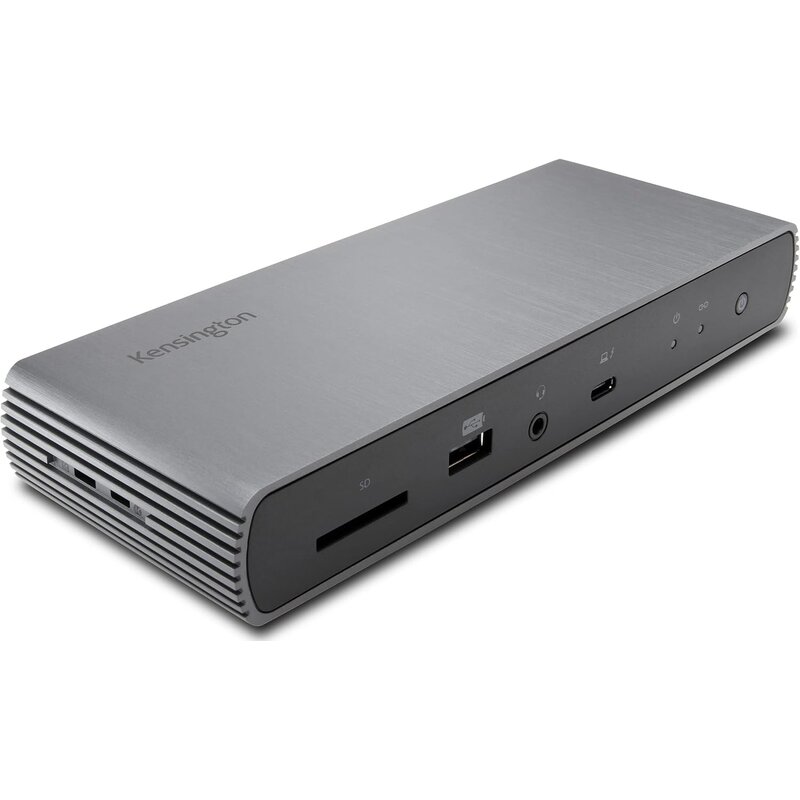
Kensington has long been a staple in corporate IT departments, and the Kensington SD5700T reflects that focus. It is a Thunderbolt 4 dock for Windows, macOS and ChromeOS, with three downstream Thunderbolt 4 ports that can each drive a monitor, a fast SSD or another hub, so you can add a second display or drive later without buying another hub.

Kensington rates it for dual 4K displays at 60Hz or a single 8K display at 30Hz, and it delivers up to 90W to the laptop. A 180W external power supply covers that plus the downstream ports, so accessories do not cut into laptop charging. Three 10Gbps USB-A ports, a 480Mbps USB-A port, Gigabit Ethernet, a UHS-II SD reader and an audio jack round out the 11 ports.

Compared with the CalDigit TS4, it offers fewer ports, slower Ethernet and slightly lower charging, which is why it ranks second. It does have a longer three-year warranty and an extra downstream Thunderbolt port, and its cross-platform support suits hot-desking offices where different laptops plug in through the week.

There are no dedicated HDMI or DisplayPort outputs, so most people will need USB-C or Thunderbolt monitor cables or adapters. Ethernet is Gigabit rather than 2.5GbE, and 90W may be short for high-power gaming laptops under heavy load, though typical office laptops rarely notice.


Pros
  • Three downstream Thunderbolt 4 ports
  • Dual 4K at 60Hz support
  • Works across Windows, Mac and ChromeOS
  • Up to 90W laptop charging with a 180W power supply
  • UHS-II SD card reader
  • 0.8-meter Thunderbolt 4 cable included
  • Three-year limited warranty
Cons
  • No built-in HDMI or DisplayPort outputs
  • Gigabit Ethernet and 90W charging may fall short for high-power laptops
PICK #3
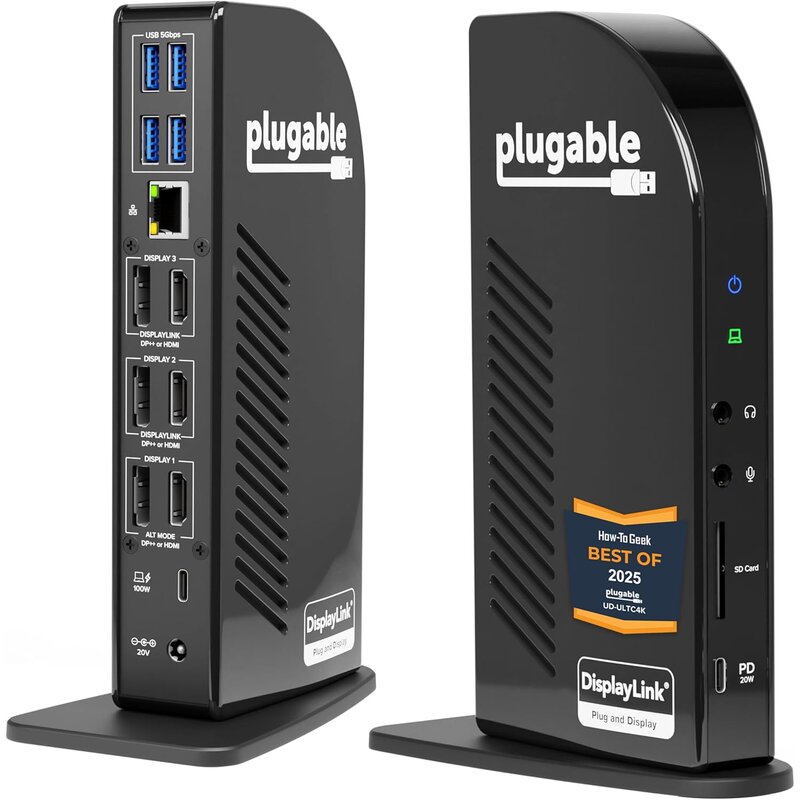
Plugable USB-C Triple 4K Display Docking Station (UD-ULTC4K)
Image courtesy of Plugable

Plugable USB-C Triple 4K Display Docking Station (UD-ULTC4K)

from Plugable
Rating
8.9 / 10
★★★★☆
Port Selection
86%
Display Support
96%
Laptop Charging
92%
Compatibility
82%
Value
88%

Plenty of people want three monitors, and plenty of laptops cannot do it on their own. The Plugable UD-ULTC4K solves that with DisplayLink technology, running up to three 4K displays at 60Hz even from computers that natively support only one external screen, including base Apple silicon MacBooks.

Each display gets both HDMI 2.0 and DisplayPort 1.2, so you can use cables you already own. Laptop charging is rated at 100W, with 96W certified, and the 13 ports include a front 10Gbps USB-C port that charges a phone at up to 20W, four 5Gbps USB-A ports, Gigabit Ethernet, a UHS-II SD reader rated up to 312 MB/s and separate audio in and out jacks.

Compared with the Dell UD22, the other DisplayLink dock, the Plugable adds a card reader and audio jacks, while the Dell supports four 4K displays. The CalDigit TS4 and Kensington SD5700T use Thunderbolt for native video. Plugable backs it with a two-year warranty and US-based support, which buyers often mention favorably.

The key requirement is the DisplayLink driver. DisplayLink video is compressed and handled partly by your computer's processor, which is excellent for spreadsheets, code and documents but less ideal for gaming or color-critical work. Some protected streaming content can behave differently, and the USB-A ports run at 5Gbps.


Pros
  • Three 4K 60Hz monitors from a single cable
  • Works around single-display Mac limits
  • HDMI and DisplayPort for each display
  • 100W laptop charging
  • Fast UHS-II SD card reader
  • Well-regarded support and two-year warranty
Cons
  • Requires DisplayLink software
  • Not ideal for gaming or color-critical work
  • USB-A ports are limited to 5Gbps
PICK #4
Anker 575 USB-C Docking Station (13-in-1)
Image courtesy of Anker

Anker 575 USB-C Docking Station (13-in-1)

from Anker
Rating
8.6 / 10
★★★★☆
Port Selection
86%
Display Support
72%
Laptop Charging
82%
Compatibility
80%
Value
94%

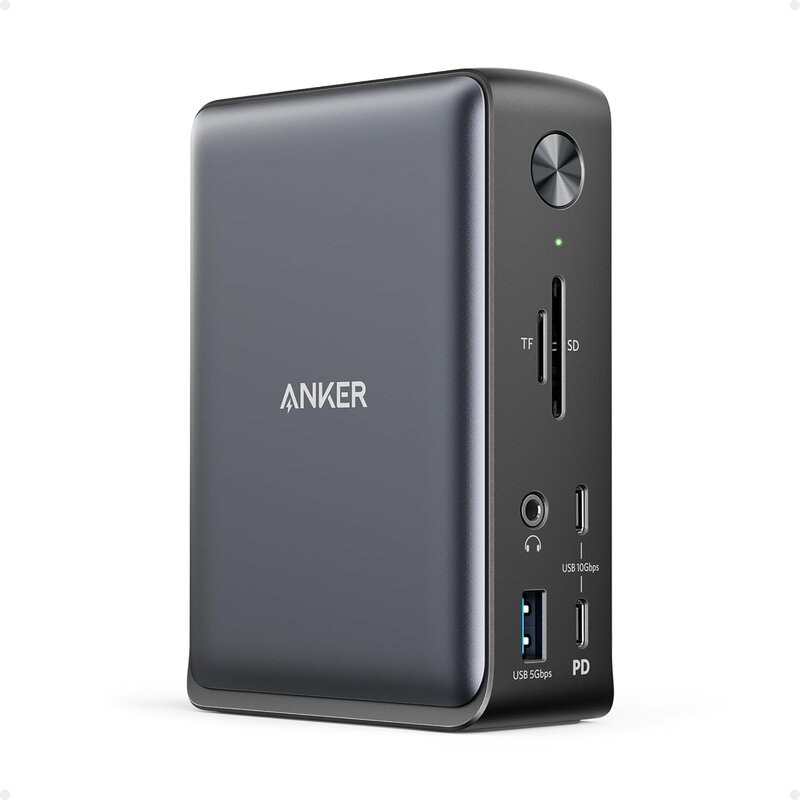
The Anker 575 gives you most of what a typical home office needs without the cost of a Thunderbolt dock. Its 13 ports include two HDMI outputs and a DisplayPort, a 10Gbps USB-C data port, an 18W USB-C port for charging a phone, three USB-A ports, Gigabit Ethernet, SD and microSD slots and a headphone jack.

A 135W adapter is included, so the dock passes up to 85W to your laptop while charging a phone. Display support needs careful reading: Anker lists one 4K display at 60Hz, two 1440p at 60Hz or three 1080p at 60Hz. Multi-monitor modes rely on MST, which Windows and ChromeOS support, but macOS does not support MST for extended displays, so Macs get one extended monitor.

Compared with the CalDigit TS4 and Kensington SD5700T, the Anker gives up Thunderbolt speed and charging power for a much lower cost. The Plugable UD-ULTC4K runs three 4K screens even on Macs through DisplayLink, and the Dell UD22 supports four.

Those display limits are why the 575 ranks fourth despite its strong value, and multi-monitor modes lower the resolution per screen. The SD readers are UHS-I rather than UHS-II, and the 18-month warranty is shorter than the competition. Mac users who need two extended screens should look at the Plugable instead.


Pros
  • Strong port selection for the price
  • Up to 85W laptop charging plus 18W phone charging
  • 135W power adapter included
  • HDMI and DisplayPort outputs built in
  • Triple 1080p monitors on Windows
  • Compact footprint
Cons
  • Macs get only one extended display
  • Multi-monitor modes lower resolution
  • Slower UHS-I card readers
  • 18-month warranty is shorter than the competition
PICK #5
Dell Universal Dock UD22
Image courtesy of Dell

Dell Universal Dock UD22

from Dell
Rating
8.4 / 10
★★★★☆
Port Selection
78%
Display Support
90%
Laptop Charging
90%
Compatibility
86%
Value
78%

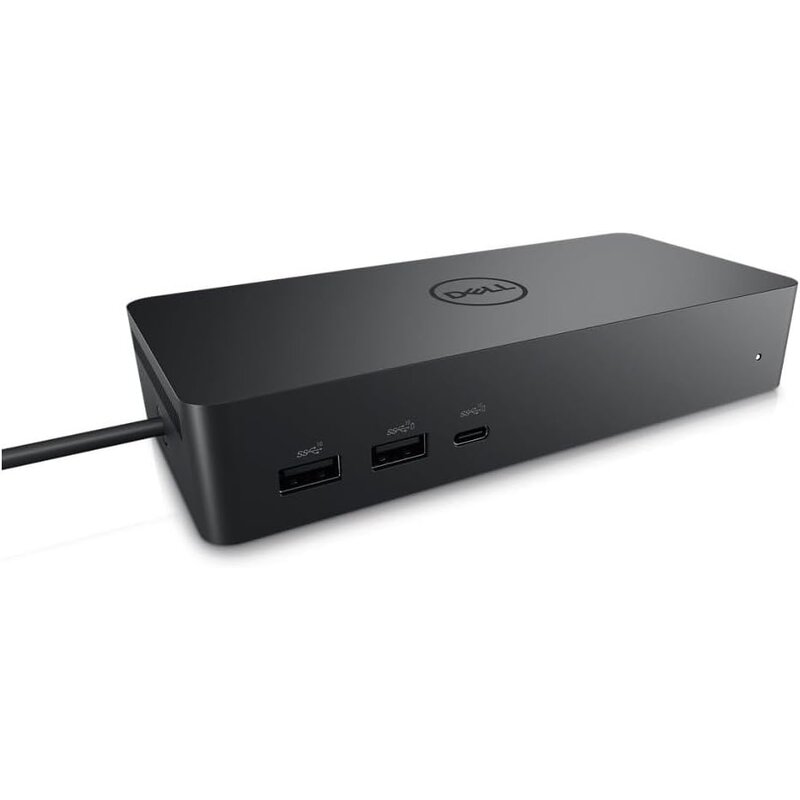
Despite the Dell name, the Dell Universal Dock UD22 is designed as a universal dock. Dell lists support for Windows 10 and 11, macOS, ChromeOS and Ubuntu, which suits offices that issue laptops from more than one brand. It delivers 96W of laptop charging over a single 2.6-foot USB-C cable that also carries displays and network.

Its biggest strength is display flexibility: Dell rates it for up to four 4K monitors at 60Hz or a single 5K display at 60Hz, using DisplayLink software for the extra screens. Outputs include two DisplayPort 1.2 connectors, an HDMI port and a USB-C port with DisplayPort, so most monitors connect without adapters.

IT-friendly touches include MAC address pass-through, wake-on-LAN and a security lock slot, which matter in managed offices. Compared with the Plugable UD-ULTC4K, the Dell adds a fourth display and network management, while the Plugable includes a card reader and audio.

As with the Plugable, multi-monitor use depends on the DisplayLink driver, with the same caveats for gaming and some protected video. It lacks a card reader and audio jack, and its 10 ports trail the CalDigit and Anker. Amazon availability often runs through third-party sellers, so confirm you are getting a new unit with Dell's warranty and check the seller's return terms.


Pros
  • Supports up to four 4K monitors
  • 96W laptop charging
  • Works across Windows, Mac, ChromeOS and Ubuntu
  • MAC address pass-through and wake-on-LAN
  • Multiple DisplayPort and HDMI outputs
Cons
  • Extra monitors require DisplayLink software
  • DisplayLink is less suited to gaming and some protected video
  • No SD card reader or audio jack
  • Only 10 ports, fewer than the CalDigit or Anker
  • Often sold through third-party sellers on Amazon

❓ What Is a Laptop Docking Station

A laptop docking station is a hub that connects a laptop to monitors, a keyboard, a mouse, wired internet, storage and a charger through a single cable. Plug the laptop in and it becomes a full desktop setup; unplug it and you are ready to leave.

Most modern docks connect over USB-C or Thunderbolt. Thunderbolt docks offer the most bandwidth for multiple high-resolution displays and fast storage, while USB-C docks are more affordable and work with a wider range of laptops. Power delivery through the same cable charges the laptop, so its wattage should match what the laptop needs.

Docks come in several forms. Compact travel hubs add a few ports in a small dongle, desktop docks offer many ports and their own power supply, and some sit vertically to hold the laptop closed. Display support is the main difference between models, and some rely on DisplayLink software to drive extra monitors on laptops with fewer native display outputs. Compatibility with your specific laptop and operating system is the most important thing to check.

Docking stations are used by hybrid and remote workers, creative professionals running several monitors, students with desk setups, and offices that share hot desks between employees.

⭐ Benefits of Laptop Docking Station

Things To Consider When Choosing the Best Laptop Docking Station

What To Avoid When Choosing Laptop Docking Station

Discover Top Laptop Docking Station
Owen Carter
Owen Carter – Research Specialist
Owen Carter is a research specialist at CompareLoft. He builds each guide by comparing manufacturer specifications, safety listings, warranty terms and patterns in verified buyer reviews. CompareLoft does not lab-test products; scores are editorial judgments based on that research.