

The Reliable Resource for Impartial Product Insights

Best 5 Smart Smoke Detectors of 2026: Smoke and CO Alarms With App Alerts

Owen Carter
By Owen Carter – Research Specialist
Owen Carter is a research specialist at CompareLoft. He builds each guide by comparing manufacturer specifications, safety listings, warranty terms and patterns in verified buyer reviews. CompareLoft does not lab-test products; scores are editorial judgments based on that research. How we review
Updated October 2026

A traditional smoke alarm does one job well: it makes a lot of noise in the room where it hangs. A smart smoke and carbon monoxide detector keeps that core job but adds a second layer: it can tell you which room has the problem, push an alert to your phone when you are away, warn you about a low battery before it starts chirping at 3 a.m., and in many cases link every alarm in the house so they sound together.

The market shifted in 2025 when Google stopped selling the Nest Protect, long the default recommendation in this category. First Alert stepped in with the SC5, which can join existing Nest Protect setups, while Kidde expanded its own app-connected line and partnered with Ring. Meanwhile, brands like X-Sense offer base-station systems that interconnect dozens of battery alarms without any wiring. The result is more choice, but also more confusion about which alarm suits which home.

To build this list we compared sensor types, listed safety standards, alarm loudness, power options, connectivity, interconnect behavior and warranty terms using manufacturer and retailer documentation, and we reviewed recurring themes in verified buyer feedback, such as nuisance alarms, setup trouble and app stability. We did not conduct our own fire or gas testing. Scores reflect our editorial judgment of how each design fits typical US homes.

One reminder before you shop: smart features are a convenience layer, not a replacement for correct placement and code requirements. Follow your local code, install alarms on every level and outside sleeping areas, and replace any alarm that has reached the end of its rated life.


Our Evaluation Standards


Dual detection and listed standards

We prioritized combination alarms with photoelectric smoke and electrochemical CO sensing, and gave weight to manufacturers that clearly state UL 217 and UL 2034 compliance.

Alerts that actually help

Voice alerts that name the hazard and room, loud sirens, phone notifications and low-battery warnings all make an alarm more useful in a real emergency.

Power and installation

Hardwired alarms suit homes with existing wiring, while battery and base-station systems suit renters and older homes. We scored how easily each fits the most common setups.

Interconnect, ecosystem and warranty

We looked at how alarms link together, whether they work with ecosystems like Ring or Google Home, optional monitoring, and how long the manufacturer stands behind the product.

#1 TOP PICK
First Alert SC5 Battery Smart Smoke & Carbon Monoxide Alarm
Image courtesy of First Alert

First Alert SC5 Battery Smart Smoke & Carbon Monoxide Alarm

from First Alert
Rating
9.4 / 10
★★★★★
Detection
95%
Alerts & Voice
95%
Smart Features
93%
Installation
92%
Value
88%

The First Alert SC5 Battery Smart Smoke & Carbon Monoxide Alarm is the closest thing to a successor for the Nest Protect, and for many households it is the easiest smart alarm to recommend. It pairs a photoelectric smoke sensor with an electrochemical CO sensor, so a single ceiling unit covers both smoke and carbon monoxide. 🏠

First Alert builds it around its Precision Detection technology, which the company says is designed to meet updated standards for early warning and fewer nuisance alarms, such as those triggered by cooking. The product page lists compliance with the UL 217 10th Edition standard, and the alarm sounds at 85 dB at 10 feet. That gives you a published, standards-based baseline rather than a vague marketing promise, and it shows the alarm was built against the updated standard rather than an older edition.

When something is wrong, the SC5 speaks. Voice alerts name the hazard and the room, with a Heads-Up warning that tells everyone in the house what type of danger was detected and where. The First Alert app sends mobile notifications whether you are home or away, so you hear about an alarm even when nobody is there to listen for it. 📱

Alarms interconnect wirelessly, so when one sounds, compatible alarms elsewhere in the house sound as well. That compatibility explicitly includes Google Nest Protect units, which means you can replace aging Protects one at a time without breaking your existing network. Because the battery model needs no wiring, it suits renters, older homes and anyone who wants smart alerts without hiring an electrician.

Compared with the Kidde P4010ACSCO-WF and the Kidde Ring model, the SC5 needs no hardwiring and names the room in its voice alerts. The X-Sense systems are also wire-free but carry warranties of up to five years. The SC5's Nest Protect compatibility is unique in this guide, and First Alert backs it with a 10-year limited warranty. ✨

The battery version runs on replaceable CR123A lithium cells and warns you in the app before they run low, which removes the classic late-night chirp. The main caveats are that CR123A batteries cost more than AA cells, and if you rely on the Nest Protect pathway, setup runs through the Google Home app and a Google account. A hardwired SC5 is also sold for homes with existing alarm wiring. If your ceilings already have that wiring, it may be the tidier choice; if not, the battery model is the simpler path.

Key Specifications
SensorsPhotoelectric smoke + electrochemical CO
Sound level85 dB at 10 ft
PowerReplaceable CR123A lithium batteries
StandardUL 217 10th Edition
InterconnectWireless with First Alert and Google Nest Protect alarms
Warranty10-year limited

Pros
  • Combination smoke and CO detection in one alarm
  • Photoelectric smoke sensor plus electrochemical CO sensor
  • Precision Detection designed for fewer nuisance alarms, such as from cooking (manufacturer)
  • Lists compliance with UL 217 10th Edition
  • Voice alerts name the hazard and the room
  • Wireless interconnect, including with Google Nest Protect
  • App alerts for emergencies and low batteries
  • No wiring needed for the battery model
  • 10-year limited warranty
Cons
  • CR123A batteries are pricier than standard AA cells
  • Nest Protect integration requires the Google Home app and account
Wrap-Up

The First Alert SC5 is the best all-around pick for homes that want smart alerts without rewiring. It combines smoke and CO detection, its voice alerts name the hazard and the room, and it interconnects wirelessly with other First Alert and Google Nest Protect alarms.
PICK #2
Rating
9.1 / 10
★★★★★
Detection
93%
Alerts & Voice
90%
Smart Features
86%
Installation
88%
Value
90%

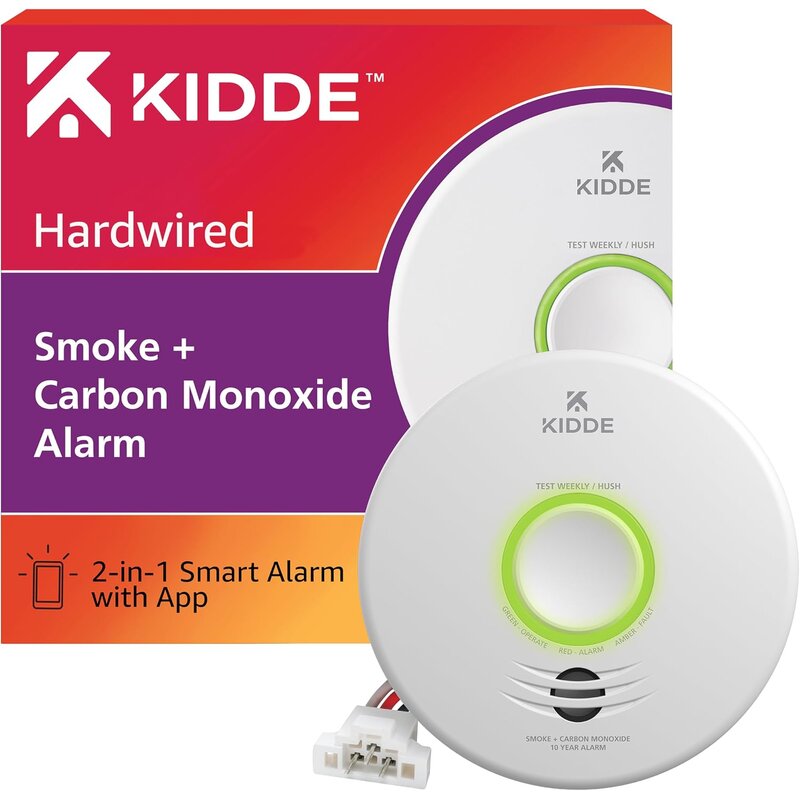
Many American homes already have a chain of hardwired, interconnected smoke alarms in the ceiling, and a lot of those are Kidde. The Kidde P4010ACSCO-WF is built for that situation: Kidde says it works with existing Kidde hardwire interconnected alarms, so when any alarm in the chain goes off, all of them sound and the smart unit sends a phone notification.

In other words, swapping just one alarm can make the whole system report to your phone, a practical upgrade for homeowners who want alerts while at work or traveling without replacing every alarm at once. It pairs a photoelectric smoke sensor with an electrochemical CO sensor, sounds at 85 decibels and calls out Fire, Warning Carbon Monoxide or end of life.

The Kidde app delivers real-time alerts and can notify friends and family, and the alarm works with Amazon Alexa and Google Home. Compared with the First Alert SC5, it keeps battery backup during power outages on a hardwired circuit, and Kidde matches First Alert with a 10-year warranty.

Because it is hardwired, installation means working with a 120V ceiling box, which some owners will prefer to leave to an electrician, so it is not ideal for renters or DIY beginners. Its voice alerts also identify the hazard but not the room.


Pros
  • Adds phone alerts to an existing Kidde hardwired chain
  • Combination smoke and CO detection
  • Voice announcements for fire, CO and end of life
  • App alerts can also notify friends and family
  • Battery backup during power outages
  • Compatible with Alexa and Google Home
  • 10-year limited warranty
Cons
  • Hardwired installation is not ideal for renters or DIY beginners
  • Voice alerts identify the hazard but not the room
PICK #3
Kidde Smart Smoke & CO Detector with Ring (RGCUAR-RW)
Image courtesy of Kidde / Ring

Kidde Smart Smoke & CO Detector with Ring (RGCUAR-RW)

from Kidde / Ring
Rating
8.9 / 10
★★★★☆
Detection
91%
Alerts & Voice
88%
Smart Features
92%
Installation
85%
Value
84%

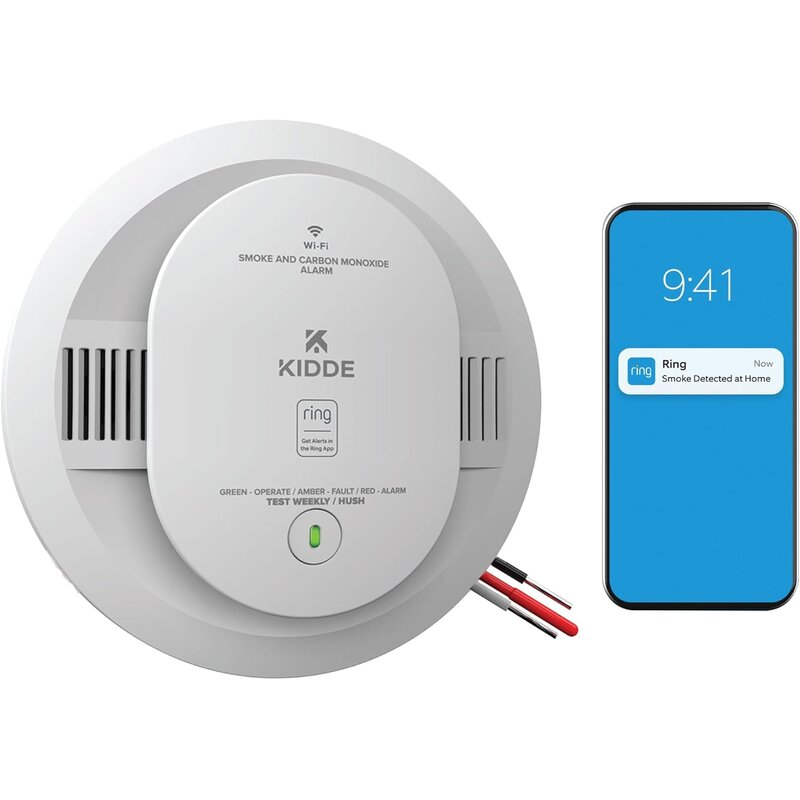
Kidde and Ring teamed up on the Kidde Smart Smoke & CO Detector with Ring so that smoke and CO events land in the same app as your doorbell, cameras and Ring Alarm sensors. Setup runs through the Ring app and does not require any other Ring hardware, but existing Ring households gain the most from having everything in one place.

The RGCUAR-RW is a hardwired 120V alarm with two AA backup batteries, and it connects over 2.4 GHz Wi-Fi. Voice alerts explain why the alarm is sounding, and the app sends real-time notifications for smoke, CO and low battery. Kidde notes that adding one to existing Kidde hardwired alarms can bring app notifications to the whole chain.

The standout is optional 24/7 professional monitoring through a Ring subscription, in which trained agents can request emergency help when an alarm triggers, useful for anyone who travels or owns a second home. Compared with the Kidde P4010ACSCO-WF, it trades Alexa and Google Home support for Ring integration, and a battery-only Ring version (RGCUDR-RW) is also sold.

There are caveats. Kidde specifies particular AA battery brands for backup and advises against lithium AAs, and Wi-Fi and full operation depend on AC power. Monitoring is a paid add-on for US addresses only, and this model needs hardwired installation.


Pros
  • Alerts appear in the Ring app alongside other Ring devices
  • Optional 24/7 professional smoke and CO monitoring
  • No other Ring hardware required for setup
  • Voice alerts explain why the alarm is sounding
  • Real-time smoke, CO and low-battery notifications
  • Can bring smart alerts to existing Kidde hardwired alarms
Cons
  • Monitoring requires a paid Ring subscription and is US-only
  • Backup battery brand requirements are strict
  • Hardwired installation needed for this model
PICK #4
Rating
8.6 / 10
★★★★☆
Detection
86%
Alerts & Voice
88%
Smart Features
87%
Installation
92%
Value
88%

X-Sense takes the base-station approach. Each X-Sense XP0A-MR combination alarm runs on a replaceable battery and talks to an SBS50 Base Station, which connects to your 2.4 GHz Wi-Fi and relays alerts to the X-Sense app, so you can interconnect alarms across a large or multi-story home without running any wiring.

That suits older houses, additions and long ranch layouts, where pulling new wire between ceilings would be expensive or disruptive. X-Sense lists a 1,700-foot wireless range, a long reach for detached garages or finished basements, and the app's low-battery warnings make each alarm easier to track. Each alarm still needs its own battery checks.

When an alarm triggers, it speaks the hazard and its location, and the app sends a real-time notification. X-Sense also offers an optional fire dispatch service and lists Home Assistant compatibility, which will appeal to tinkerers who want their alarms inside a broader automation setup. Compared with the XP0A-iR, it adds the base station and long range, but the two cannot be mixed in one network.

Everything depends on the SBS50, so a power or Wi-Fi problem there affects app alerts, although the alarms still sound locally. Wi-Fi is 2.4 GHz only, and the warranty is described as up to five years, shorter than the 10-year coverage from First Alert and Kidde.


Pros
  • Wire-free interconnect across large homes
  • 1,700-foot stated wireless range
  • Voice alerts include the alarm's location
  • App alerts and low-battery warnings
  • Optional fire dispatch service
  • Home Assistant support listed
Cons
  • Requires the SBS50 base station for smart features
  • App alerts depend on the base station's power and Wi-Fi
  • Warranty is shorter than First Alert and Kidde
  • 2.4 GHz Wi-Fi only
PICK #5
Rating
8.2 / 10
★★★★☆
Detection
84%
Alerts & Voice
84%
Smart Features
80%
Installation
94%
Value
92%

The X-Sense XP0A-iR is X-Sense's answer for people who want phone alerts without buying or placing a base station. Each alarm connects directly to your 2.4 GHz Wi-Fi network and reports to the X-Sense app, so a single unit in an apartment hallway or a small house can be up and running in minutes. There is no extra box to place near the router.

It runs on a replaceable battery with nothing to install beyond a ceiling mount, which makes it a sensible choice for renters who can take the alarms with them when they move. Multi-packs make it straightforward to cover several bedrooms and a kitchen area at once.

It keeps the essentials: combination smoke and CO detection, a voice alarm that announces the location, and real-time app and low-battery alerts. For a small household, that covers the main reason to go smart. Compared with the XP0A-MR, it trades long-range interconnect for simpler, hub-free setup, while the First Alert SC5 adds Nest Protect compatibility and a longer warranty.

The XP0A-iR is not compatible with the SBS50, so it cannot join an existing XP0A-MR network, and buyers should check how interconnection works across their multi-pack before relying on it for whole-home coverage. Direct Wi-Fi typically shortens battery life compared with base-station designs, and the warranty is up to five years.


Pros
  • No hub or base station needed
  • Combination smoke and CO detection
  • Voice alarm with location
  • Real-time app and low-battery alerts
  • Renter-friendly, no wiring required
Cons
  • Not compatible with the X-Sense SBS50 base station
  • Check how your multi-pack interconnects before relying on whole-home coverage
  • Direct Wi-Fi design tends to shorten battery life
  • 2.4 GHz Wi-Fi only
  • Shorter warranty than the top picks

❓ What Is a Smart Smoke Detector

A smart smoke detector is a smoke alarm that connects to your home network and sends alerts to your phone when it detects smoke, and often carbon monoxide. It sounds a local alarm like a standard detector, but also lets you know about a problem when you are away from home.

Detectors use photoelectric sensors, ionization sensors or both to sense smoke, and combination units add an electrochemical carbon monoxide sensor. Smart models connect through Wi-Fi, a smart-home hub or a wireless protocol, and many interconnect so that when one alarm sounds, the others in the home sound too. Apps can show which room triggered the alarm and let you silence a nuisance alert from your phone.

Some smart detectors replace your existing alarms entirely, while smart listeners and retrofit devices hear existing alarms and forward the alert to your phone. Models come in hardwired and battery-powered versions, and features such as voice announcements, self-tests, low-battery notifications and night lights vary between brands. Checking local code requirements and certification listings is a sensible first step.

Smart smoke detectors suit homeowners, renters who travel, landlords managing rental properties, and families who want alerts when relatives or pets are home alone.

⭐ Benefits of Smart Smoke Detector

Things To Consider When Choosing the Best Smart Smoke Detector

What To Avoid When Choosing Smart Smoke Detector

Discover Top Smart Smoke Detector
Owen Carter
Owen Carter – Research Specialist
Owen Carter is a research specialist at CompareLoft. He builds each guide by comparing manufacturer specifications, safety listings, warranty terms and patterns in verified buyer reviews. CompareLoft does not lab-test products; scores are editorial judgments based on that research.