The Reliable Resource for Impartial Product Insights

Best 5 Water Leak Detectors of 2026: Smart Sensors That Catch Drips Early

Owen Carter
By Owen Carter – Research Specialist
Owen Carter is a research specialist at CompareLoft. He builds each guide by comparing manufacturer specifications, safety listings, warranty terms and patterns in verified buyer reviews. CompareLoft does not lab-test products; scores are editorial judgments based on that research. How we review
Updated October 2026

A slow drip under a sink or a weeping water heater rarely announces itself. By the time you notice a soft spot in the floor or a musty smell in the basement, the water has often been spreading for days. A water leak detector is one of the least expensive ways to shorten that window from days to seconds: a small puck sits on the floor, and the moment its probes touch water it sounds an alarm and, on smart models, pushes an alert to your phone.

The category has changed a lot in the last few years. Basic standalone alarms still exist, but most shoppers now want a sensor that can reach them when they are at work or on vacation. That means choosing between direct Wi-Fi sensors, hub-based systems that use long-range radio like LoRa or Sub-GHz, and sensors that piggyback on an ecosystem you already own, such as Ring, Apple Home or Alexa. Each approach trades off battery life, range, setup effort and how well alerts survive a router or internet outage.

For this guide we compared manufacturer specifications, alarm volume, battery ratings, wireless range, ecosystem support and warranty terms, and we looked for recurring patterns in verified buyer reviews, such as false alarms, dropped connections and app reliability. We did not run our own flood tests; the scores below are editorial judgments based on that published information and on how well each design fits common household situations.

Below you will find our five picks, what each one does best, where it falls short, and a buying guide that explains how to match a detector to your home, whether you need one sensor under the dishwasher or a dozen spread across a finished basement.


Our Evaluation Standards


Alert reliability

A leak detector only matters if the alert reaches you. We weighted how each system delivers notifications (app push, email, SMS, local siren) and whether it keeps working when Wi-Fi or the internet goes down.

Range and connectivity

Basements, crawl spaces and detached laundry rooms are often far from the router. We favored long-range radio systems and gave credit for clearly stated range figures and hub capacity.

Battery life and upkeep

Sensors live in places you rarely check. Rated battery life, low-battery warnings and use of common battery sizes all affected scores.

Smart-home fit and value

We considered integrations with Alexa, Google Home, Apple Home, IFTTT and shutoff valves, along with what you get in the box for a typical multi-sensor setup.

#1 TOP PICK
YoLink Water Leak Sensor 4 Starter Kit (Hub + 4 Sensors)
Image courtesy of YoLink

YoLink Water Leak Sensor 4 Starter Kit (Hub + 4 Sensors)

from YoLink
Rating
9.4 / 10
★★★★★
Detection & Alerts
95%
Connectivity
97%
Battery Life
94%
Smart Integration
88%
Value
90%

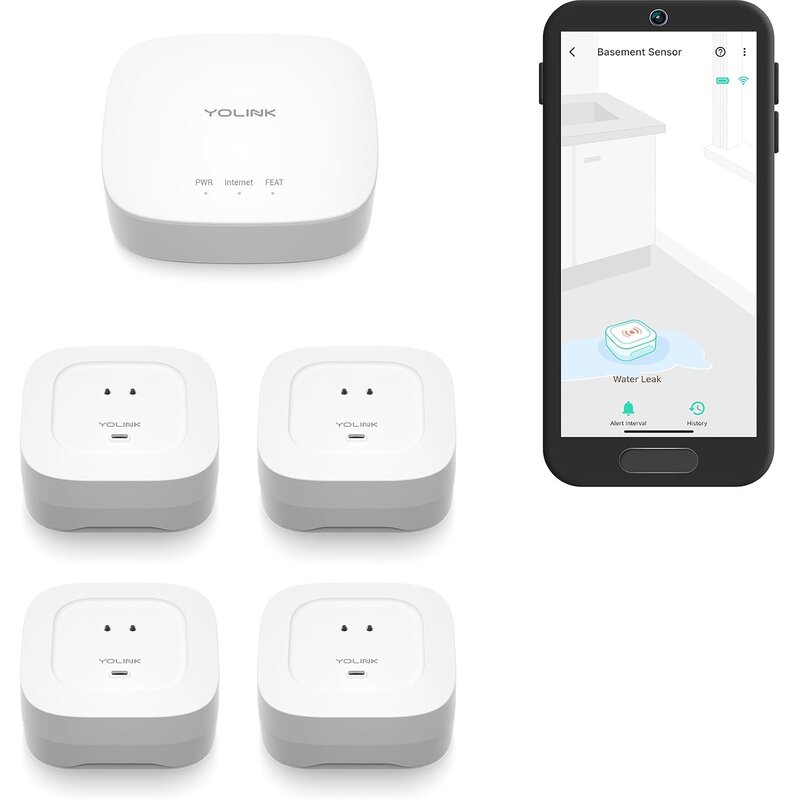
The YoLink Water Leak Sensor 4 Starter Kit earns our top spot because it solves the two problems that sink most cheap smart leak sensors: weak range and short battery life. The kit pairs a hub with four sensors that talk over LoRa, a low-power radio designed for long distances, and YoSmart rates the system at up to a quarter mile in open air. 🏠

In a real house, walls and floors cut that figure down, but the extra headroom matters when the water heater sits in a far corner of a basement or the sump pit is in a detached garage. Each Leak Sensor 4 carries its own 105 dB siren, so anyone at home hears the problem even if a phone is on silent. Alerts go out through the YoLink app, and the company advertises SMS and email options as well. 💧

The feature that sets YoLink apart is Control-D2D: a sensor can be paired directly with a YoLink siren or water shutoff valve, so the response still happens if your Wi-Fi drops or the internet is out. For a device whose whole job is to work during a bad day, that kind of local fallback is valuable, especially in vacation homes and rentals.

Battery life is rated at more than five years on two AAA cells, and AAA batteries are easy to find. The hub connects by Ethernet or 2.4 GHz Wi-Fi and supports 300-plus devices, which leaves plenty of room to add more sensors, sirens or valves later as your setup grows. A five-plus-year rating also means fewer trips under sinks and behind appliances to swap cells. 🔋

Compared with the GoveeLife 1s, YoLink adds offline Control-D2D; compared with the Moen Flo and Aqara, it offers longer range and longer rated battery life. It also works with Alexa, IFTTT and Home Assistant, so basic automations such as announcing a leak or flashing a light are within reach. The Ring sensor runs longer on its batteries, but it does not publish a siren volume.

The trade-offs are mostly about ecosystem. You need the YoLink hub, and it is not a native Apple Home or Google Home device. Buyers also mention that the app is dense with settings and has a learning curve. If you can live with that, this is our top all-around kit for homes with basements or outbuildings.

Key Specifications
AlarmBuilt-in 105 dB siren per sensor
WirelessLoRa, up to 1/4 mile open-air range
Battery2 x AAA per sensor, rated 5+ years
HubYoLink Hub, Ethernet or 2.4 GHz Wi-Fi, 300+ devices
Offline controlControl-D2D direct device pairing

Pros
  • Starter kit includes the hub and four sensors
  • Long LoRa range reaches basements and outbuildings
  • Loud 105 dB siren built into every sensor
  • Rated 5+ year battery life on common AAA cells
  • Control-D2D lets sensors trigger sirens or valves without internet
  • Alerts through the YoLink app, with SMS and email options advertised
  • Hub connects by Ethernet or 2.4 GHz Wi-Fi
  • Hub supports a large number of devices for future expansion
  • Works with Alexa, IFTTT and Home Assistant
Cons
  • Requires the YoLink hub; no native Apple Home support
  • App has a learning curve with many menus
Wrap-Up

The YoLink Water Leak Sensor 4 Starter Kit is the best all-around pick for homes with basements or outbuildings. Its LoRa range reaches distant spots, every sensor has a loud 105 dB siren, and Control-D2D lets sensors trigger sirens or valves without internet, with batteries rated for 5+ years.
PICK #2
GoveeLife Smart Water Leak Detector 1s (H5059) with Wi-Fi Gateway
Image courtesy of GoveeLife

GoveeLife Smart Water Leak Detector 1s (H5059) with Wi-Fi Gateway

from GoveeLife
Rating
9.1 / 10
★★★★★
Detection & Alerts
92%
Connectivity
92%
Battery Life
94%
Smart Integration
85%
Value
95%

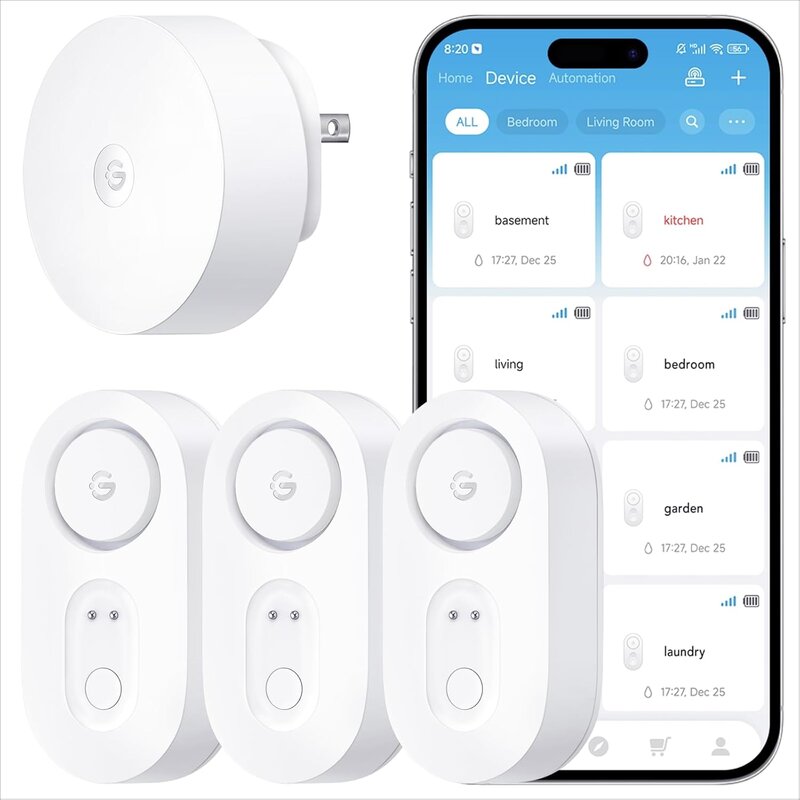
Govee's original Wi-Fi leak sensor became a best seller because it was affordable and simple. The newer GoveeLife Water Leak Detector 1s keeps that formula and fixes the old weak points. The sensors use a Sub-1G radio rated for up to 1,804 feet to the gateway, and the alarm tops out at 105 dB with app-adjustable volume, handy near bedrooms.

Rated battery life stretches to five years with batteries included, and the IP67 rating means a sensor sitting in a puddle is not a problem. The gateway joins 2.4 GHz Wi-Fi, relays alerts to the Govee Home app and email, and manages up to 64 sensors.

It works with Alexa, Google Home and IFTTT for basic automations, and multi-packs make it easy to cover every sink, toilet, washer and water heater in one purchase. That is where its multi-pack value shows, and it offers longer rated battery life and a published alarm level than the Moen Flo or Aqara.

Compared with YoLink, you give up local resilience: alerts depend on the gateway reaching the internet, so a router outage leaves only the on-sensor siren. The 1s gateway also pairs only with newer H5059-family sensors, not older H5054 units, and supports 2.4 GHz Wi-Fi only.


Pros
  • Strong value for multi-sensor coverage
  • Adjustable alarm up to 105 dB
  • Long Sub-1G range to the gateway
  • IP67 sensors handle standing water
  • Rated battery life up to five years
  • One gateway manages up to 64 sensors
  • Works with Alexa, Google Home and IFTTT
Cons
  • Phone alerts stop if Wi-Fi or internet goes down
  • Gateway is 2.4 GHz only and does not pair with older Govee leak sensors
PICK #3
Moen Flo Smart Water Detector 920-005 (3-Pack)
Image courtesy of Moen

Moen Flo Smart Water Detector 920-005 (3-Pack)

from Moen
Rating
8.8 / 10
★★★★☆
Detection & Alerts
90%
Connectivity
84%
Battery Life
80%
Smart Integration
90%
Value
82%

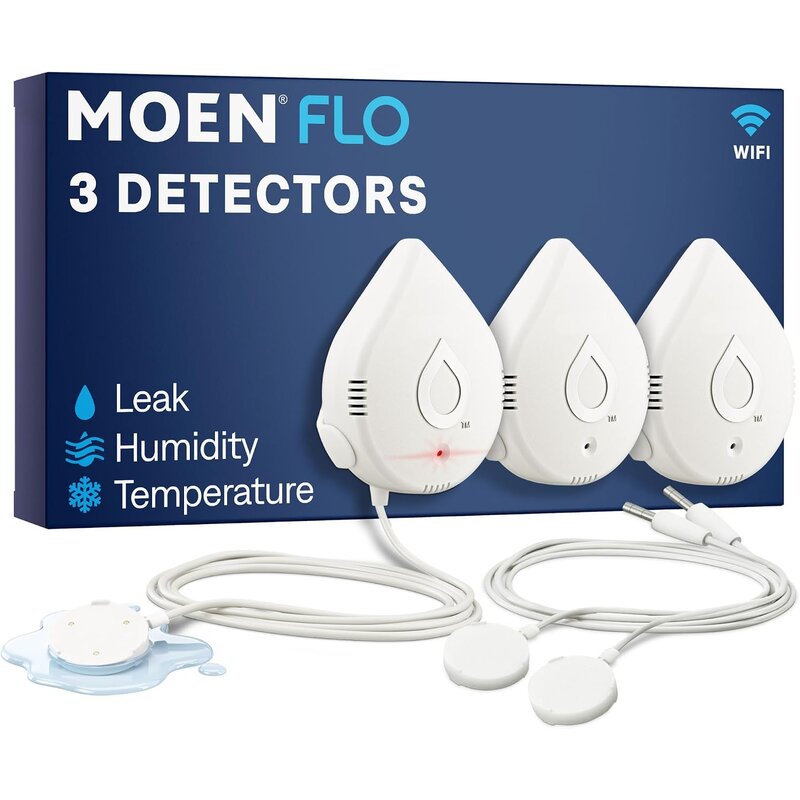
The Moen Flo Smart Water Detector is the pick for people who want more than a wet-floor alarm. Each unit monitors moisture, relative humidity from 0 to 100 percent and temperature from 0 to 140°F, with custom alert thresholds in the Moen app. That suits a damp crawl space, a humid laundry room or a cabin where falling temperatures can mean frozen pipes.

It connects straight to 2.4 GHz Wi-Fi, so there is no hub to buy or place. The detector can sit on the floor, or you can wall-mount it and run the included 48-inch remote sensing disc behind an appliance or under a vanity. Moen also sells an optional six-foot leak sensing cable.

If you own Moen's Flo Smart Water Monitor and Shutoff, a detector alert can close the main valve automatically. Compared with the Ring sensor, which also watches temperature, the Moen adds humidity monitoring and needs no Sidewalk bridge, while the Aqara is smaller and suits Apple Home.

The price of direct Wi-Fi is battery life: Moen rates the CR123A cell at up to two years, well short of YoLink and GoveeLife, and CR123A batteries are pricier than AAAs. The warranty is one year, and YoLink and GoveeLife also publish 105 dB sirens.


Pros
  • Monitors humidity and temperature as well as water
  • Custom alert thresholds in the Moen app
  • No hub required; connects directly to Wi-Fi
  • Remote sensing disc reaches tight spots
  • Optional leak-sensing cable for wider coverage
  • Can trigger Moen Flo automatic water shutoff
Cons
  • Battery rated at up to two years, shorter than hub-based rivals
  • Uses CR123A batteries instead of common AAA cells
  • Only a one-year warranty
PICK #4
Ring Flood & Freeze Sensor
Image courtesy of Ring

Ring Flood & Freeze Sensor

from Ring
Rating
8.5 / 10
★★★★☆
Detection & Alerts
84%
Connectivity
86%
Battery Life
96%
Smart Integration
84%
Value
80%

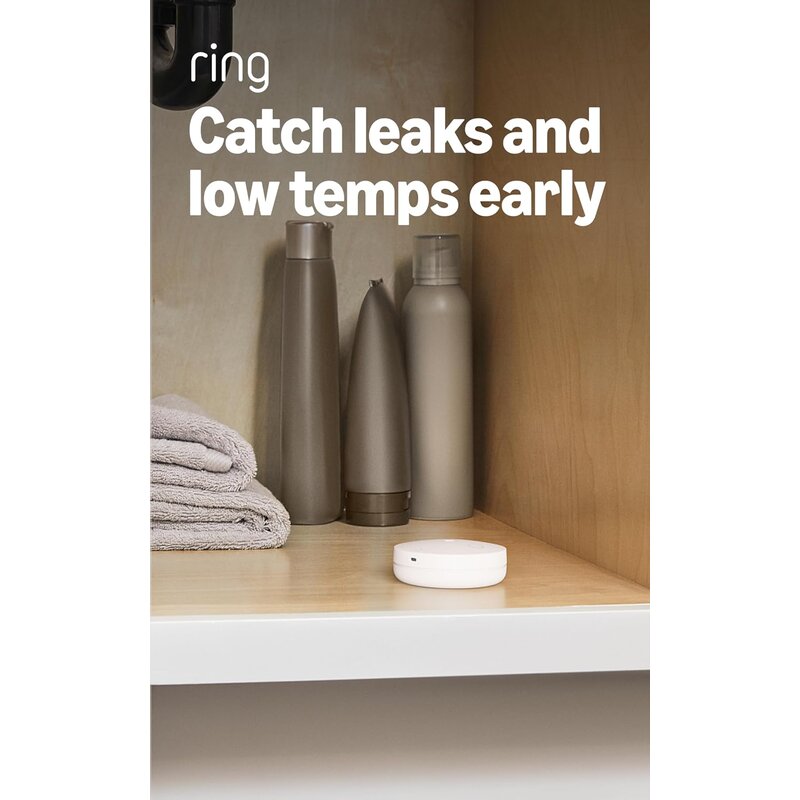
The Ring Flood & Freeze Sensor connects over Amazon Sidewalk, the low-bandwidth network created by compatible Echo and Ring devices, rather than Wi-Fi or a dedicated hub. Ring states that no hub or base station is required, and because Sidewalk is independent of your router, you will not need to re-pair it after changing routers.

It watches for both water and cold temperatures, so one device covers a leaking washer hose and a pipe at risk of freezing. Ring rates battery life at up to roughly six years on two AA cells, the longest rated figure in our roundup, and the IP66 rating helps it shrug off splashes.

The puck is 2.76 inches across, and alerts land in the Ring app next to doorbell and camera notifications. Compared with the Moen Flo, it offers longer battery life and no Wi-Fi setup but no humidity readings, making it an excellent add-on for Ring owners rather than a standalone system.

The catch is that Sidewalk coverage depends on a compatible bridge nearby, typically a recent Echo speaker or certain Ring products, and homes without one may find setup frustrating. Ring also does not publish a siren volume, so we would not count on it to wake a sleeping house the way YoLink or GoveeLife can.


Pros
  • Detects both leaks and low temperatures
  • No hub or Wi-Fi password needed
  • No re-pairing after changing routers
  • Longest rated battery life in this guide
  • IP66 rating for wet locations
  • Alerts appear alongside other Ring notifications
Cons
  • Relies on Amazon Sidewalk bridge coverage near the sensor
  • Homes without a compatible Echo or Ring bridge may find setup frustrating
  • No published siren volume; best treated as an app-alert device
  • No humidity readings, unlike the Moen Flo
PICK #5
Aqara Water Leak Sensor
Image courtesy of Aqara

Aqara Water Leak Sensor

from Aqara
Rating
8.2 / 10
★★★★☆
Detection & Alerts
82%
Connectivity
78%
Battery Life
80%
Smart Integration
94%
Value
86%

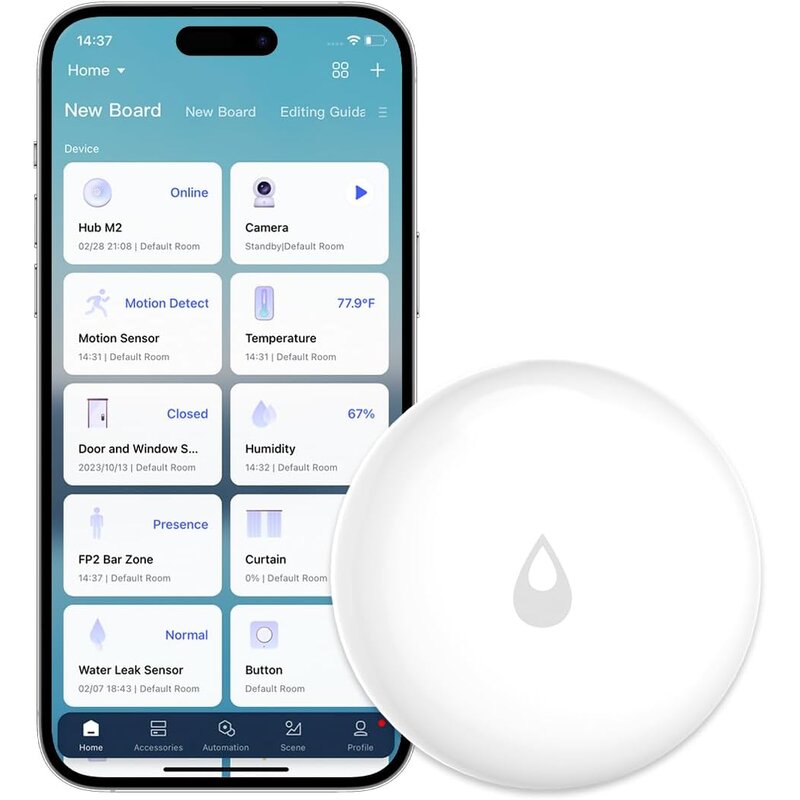
If your smart home runs on Apple Home, the Aqara Water Leak Sensor is the easiest way to add water alerts that show up natively in the Home app. It is a Zigbee device, so it needs an Aqara hub, but once paired it also works with Alexa, Google Assistant and IFTTT.

That opens the door to automations such as flashing lights, announcing a leak on a smart speaker, or closing a compatible smart valve, all inside the system Apple-centric households already use for their scenes.

The sensor is tiny, just under two inches square, with an IP67 rating and a built-in buzzer that sounds when water bridges the contacts. It tucks beside a toilet base or inside a sink cabinet where bulkier pucks do not fit, which suits apartments and smaller homes where range matters less.

Compared with YoLink and GoveeLife, it gives up range and battery life for native Apple Home support. Zigbee reaches much less far than LoRa or Sub-GHz systems, so a distant basement sensor may need a repeater or second hub. The CR2032 cell is rated at up to two years, Aqara publishes no buzzer decibel rating, and the hub adds to the cost of a first sensor.


Pros
  • Native Apple Home support through an Aqara hub
  • Also works with Alexa, Google Assistant and IFTTT
  • Very compact design fits tight spaces
  • IP67 dust and water rating
  • Good building block for leak automations
Cons
  • Requires an Aqara hub, adding to the cost of a first sensor
  • Zigbee range is shorter than LoRa or Sub-GHz systems
  • Far-away sensors may need a Zigbee repeater or second hub
  • Coin-cell battery rated at only up to two years
  • No published alarm volume

❓ What Is a Water Leak Detector

A water leak detector is a small sensor placed where leaks tend to start, such as under sinks, behind toilets, beside water heaters and near washing machines. When water touches its probes it sounds an alarm, and smart models also send an alert to your phone.

Most detectors use contact probes on the underside that complete a circuit when water bridges them. Some models add a sensing cable that runs along a longer area, and many also measure temperature and humidity to warn of freezing pipes or damp conditions. Smart sensors connect to Wi-Fi directly or through a hub, and hub-based systems often reach farther and run longer on batteries.

Detectors range from simple standalone units with a loud local alarm to whole-home systems linked to an automatic shut-off valve that closes the main water supply when a leak is detected. Battery-powered sensors are easy to place anywhere, and smart-home integrations let one sensor trigger lights, sirens or other devices.

Homeowners and renters use leak detectors to catch slow drips and sudden bursts early. They are especially useful in basements, vacation homes, rental properties and homes with appliances in finished spaces where water damage would be costly to repair.

⭐ Benefits of Water Leak Detector

Things To Consider When Choosing the Best Water Leak Detector

What To Avoid When Choosing Water Leak Detector

Discover Top Water Leak Detector
Owen Carter
Owen Carter – Research Specialist
Owen Carter is a research specialist at CompareLoft. He builds each guide by comparing manufacturer specifications, safety listings, warranty terms and patterns in verified buyer reviews. CompareLoft does not lab-test products; scores are editorial judgments based on that research.