The Reliable Resource for Impartial Product Insights

Best 5 Wood Moisture Meters of 2026: Pin and Pinless Picks

Owen Carter
By Owen Carter – Research Specialist
Owen Carter is a research specialist at CompareLoft. He builds each guide by comparing manufacturer specifications, safety listings, warranty terms and patterns in verified buyer reviews. CompareLoft does not lab-test products; scores are editorial judgments based on that research. How we review
Updated October 2026

Wood never stops reacting to the air around it. Lumber that looks dry at the yard can still be carrying enough moisture to shrink, cup or crack once it is glued into a tabletop or nailed down as flooring. A good moisture meter takes the guesswork out of that process, telling you whether boards have acclimated, whether firewood is ready to burn, or whether a damp patch behind trim is a fresh leak or an old stain.

There are two main types. Pin meters push two small electrodes into the wood and measure electrical resistance between them, which lets them read at a known depth and often across a wide moisture range. Pinless meters use an electromagnetic sensor pad pressed against the surface, so they leave no holes and can scan a large board quickly, but they read to a fixed depth and need flat contact. Neither is universally better; the right choice depends on what you build and how much finished surface you need to protect.

For this guide we compared manufacturer specifications, published measurement ranges and depths, species-correction features, warranty terms and recurring patterns in verified buyer reviews. We did not run bench tests of our own, so our scores are editorial judgments based on documented features and how well each meter fits common jobs.

Our five picks span serious woodworking and flooring tools down to an affordable meter for checking firewood and walls around the house. Below you will find what each one does well, the trade-offs to know about, and a buying guide that explains which specs matter for your projects.


Our Evaluation Standards


Range and accuracy

We compared published moisture-content ranges, resolution and accuracy statements, plus how each meter handles species differences. Meters that publish clear accuracy figures and offer species or calibration checks scored higher.

Measurement method and depth

Pin and pinless meters solve different problems. We looked at pin length and penetration, pinless scan depth, and whether a meter can accept external electrodes for deeper readings in thick stock.

Build and warranty

A meter that rides in a tool bag needs to survive drops and dust. We considered construction, protective boots or cases, drop ratings where published, and the length of the manufacturer warranty.

Usability and versatility

Clear displays, hold functions, alarms, memory and the ability to read drywall or masonry in addition to wood all make a meter more useful day to day, especially for home inspection and renovation work.

#1 TOP PICK
Wagner Meters Orion 930 Pinless Wood Moisture Meter
Image courtesy of Wagner Meters

Wagner Meters Orion 930 Pinless Wood Moisture Meter

from Wagner Meters
Rating
9.5 / 10
★★★★★
Accuracy & Range
95%
Ease of Use
92%
Build Quality
94%
Versatility
84%
Value
82%

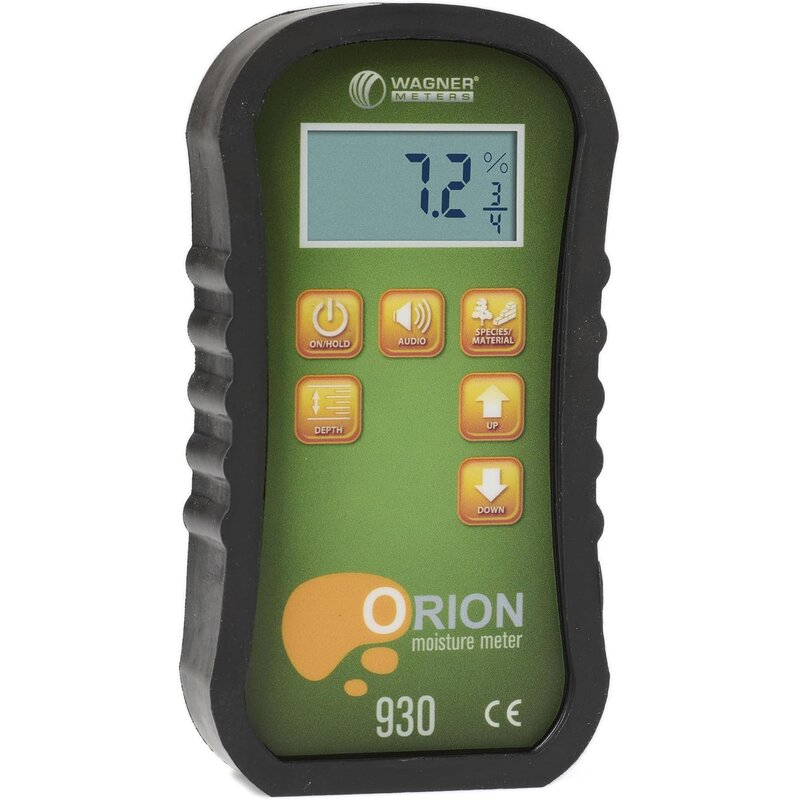
The Wagner Meters Orion 930 is the meter we would hand to anyone who works with finished or expensive lumber. Its pinless sensor reads without leaving a mark, and the dual-depth design switches between a shallow 0.25-inch scan for thin stock or veneered panels and a deep 0.75-inch scan for typical 4/4 and thicker boards. It is aimed at woodworkers and flooring installers rather than casual users. 🪵

Wagner's IntelliSense technology is designed to reduce the influence of surface moisture, which is a common weakness of pinless meters. Because there are no pins to drive, you can sweep the meter across a whole board or a stack of flooring in seconds, which makes it practical for checking material before glue-ups, finishing or flooring installation.

Calibration is a real differentiator. The kit includes a paired on-demand calibrator you can use any time, so you can verify the meter in the shop or on the job site in under a minute instead of sending it away. That keeps readings trustworthy through a long project without waiting on a service visit. For installers who check many rooms or deliveries, that convenience adds up quickly. ✨

Wagner states that the Orion series can be set for practically any softwood or hardwood species, plus engineered products such as plywood, OSB, MDF and many bamboo flooring products. A hold button, auto shutoff and a programmable high-moisture alarm round out the feature set, and the protective boot and foam-lined case help it survive daily use. That breadth means one meter can cover a cabinet build, a plywood subfloor and a bamboo floor install.

Compared with the Klein ET140, the other pinless pick, the Orion offers species settings and dual depth; compared with the Delmhorst and Lignomat pin meters, it leaves no marks on finished faces. That combination is why it ranks first for woodworkers and flooring installers who handle valuable stock. 🔨

The limits come with the pinless approach. The 4 to 32 percent range suits woodworking and flooring but does not cover very wet green lumber, and you need a flat, clean surface with full contact for reliable readings. It is a premium tool that runs on a 9V battery, backed by a seven-year warranty that makes it a long-term investment for a shop or flooring business. If you mostly check rough or green lumber, the Delmhorst JX-20 and its 6 to 60 percent range are the better fit.

Key Specifications
TypePinless, dual depth
Scan depth0.25 in. (shallow) or 0.75 in. (deep)
Wood MC range4% to 32% (varies slightly by species setting)
CalibrationPaired on-demand calibrator included
Power9V battery
Warranty7 years

Pros
  • Non-damaging pinless readings
  • Switchable shallow and deep scan modes
  • IntelliSense design reduces surface-moisture influence
  • On-demand calibrator included
  • Species settings for hardwoods, softwoods and engineered wood
  • Fast sweeps across whole boards or flooring stacks
  • Hold function and moisture alarm
  • Protective boot and foam-lined case
  • Seven-year manufacturer warranty
Cons
  • Range tops out at about 32% MC
  • Needs flat, full contact for accurate readings
  • Premium cost for hobby use
Wrap-Up

The Wagner Orion 930 is the best all-around meter for anyone who wants readings without marking the wood. Its pinless sensor switches between shallow and deep scan modes, ships with a paired calibrator and species settings for hardwoods, softwoods and engineered wood, and carries a seven-year warranty.
PICK #2
Delmhorst JX-20/P01 Digital Wood Moisture Meter Package
Image courtesy of Delmhorst

Delmhorst JX-20/P01 Digital Wood Moisture Meter Package

from Delmhorst
Rating
9.2 / 10
★★★★★
Accuracy & Range
94%
Ease of Use
82%
Build Quality
92%
Versatility
88%
Value
78%

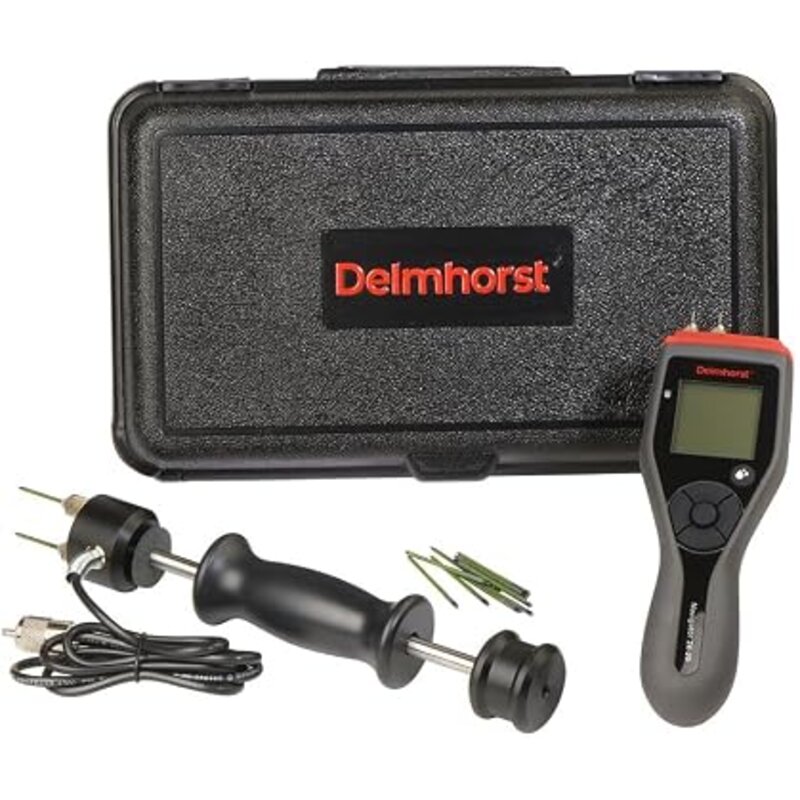
Delmhorst has built pin meters for professional lumber, flooring and restoration work for decades, and the Delmhorst JX-20 is its current wood-focused model. Its 6 to 60 percent range covers kiln-dried hardwood to freshly sawn boards, and corrections for 74 species plus wood temperature help turn raw readings into numbers you can act on.

The P01 package adds a carrying case, spare pins and a hammer electrode that drives deeper than the 5/16-inch integral pins, so sawyers and flooring installers can check moisture at the core of thick slabs or stacked lumber that dries unevenly.

On-screen statistics track high, low, average and standard deviation, ideal for checking a stack of lumber or a room of flooring before installation. A user-set alarm, color-coded LEDs and an automatic backlight make it quick to read in a dim basement, and it runs on two AA batteries with a two-year warranty.

Compared with the Lignomat, it offers a wider 6 to 60 percent range and a full species library; the Wagner avoids pin marks but stops at about 32 percent. As a pin meter it leaves small holes, the extra features bring a learning curve, and the package is a significant purchase for occasional use.


Pros
  • Wide 6% to 60% range for green and dry wood
  • Corrections for 74 species plus temperature
  • Hammer electrode for deeper readings included in package
  • Statistics for averaging many readings
  • User-set moisture alarm
  • Backlit display with color-coded LEDs
  • Runs on common AA batteries
Cons
  • Pins leave small holes in the surface
  • More menus and setup than basic meters; overkill for occasional DIY checks
PICK #3
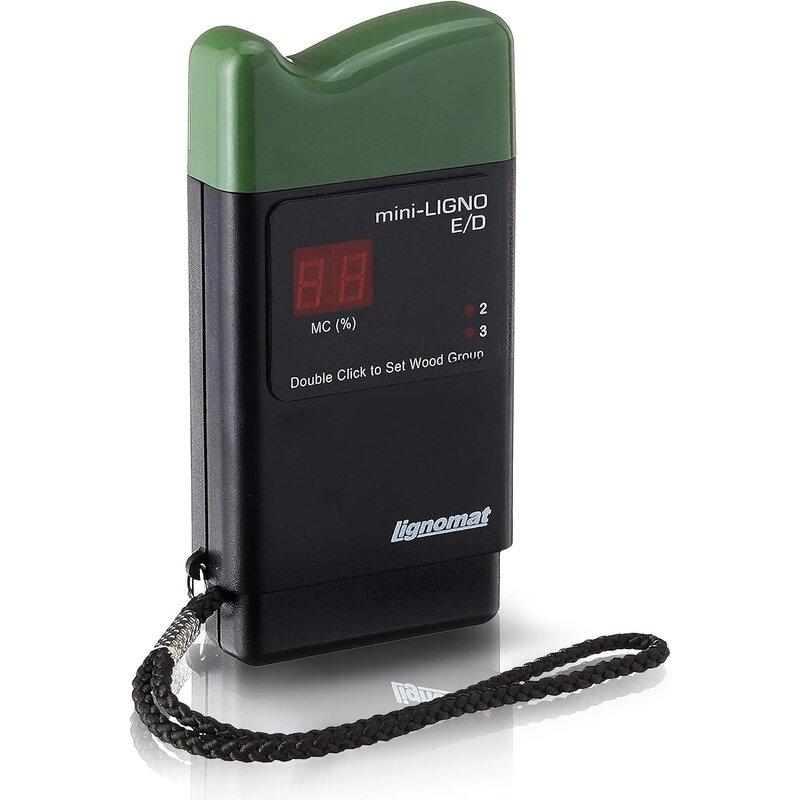
Lignomat Mini-Ligno E/D Pin Moisture Meter
Image courtesy of Lignomat

Lignomat Mini-Ligno E/D Pin Moisture Meter

from Lignomat
Rating
8.8 / 10
★★★★☆
Accuracy & Range
86%
Ease of Use
88%
Build Quality
86%
Versatility
72%
Value
88%

The Lignomat Mini-Ligno E/D is a compact, no-nonsense pin meter with a loyal following among furniture makers and cabinet shops. It reads from 6 to 45 percent, covering air-dried and kiln-dried stock, and ships with short 3/16-inch pins for thin material and longer 7/16-inch pins for deeper core readings in thicker boards.

Simplicity is the point. Two settings handle softwoods, hardwoods and panel products, and a laminated species card helps you interpret readings for specific woods, so there are no long menus or species codes to learn before a weekend project.

An automatic calibration check runs before every measurement, and the display shows tenths of a percent below 10 percent, where precision matters most for furniture work. Its pocket size makes it easy to keep at the bench or carry to a lumberyard, and the meter carries a two-year warranty.

Compared with the Delmhorst JX-20, it has no data memory and only two correction settings, and the Wagner and Klein avoid pin marks altogether. There is no pinless mode, so test on an end, edge or underside of finished stock, and some buyers prefer a larger screen. Its strength is fine resolution in a sensible first serious meter for a home shop.


Pros
  • Pocket-sized and simple to use
  • Two pin lengths included
  • Automatic calibration check every reading
  • Fine 0.1% resolution below 10% MC
  • Species reference card included
  • Two-year meter warranty
Cons
  • Only two species correction settings
  • No memory or data features
  • Pins mark finished surfaces
PICK #4
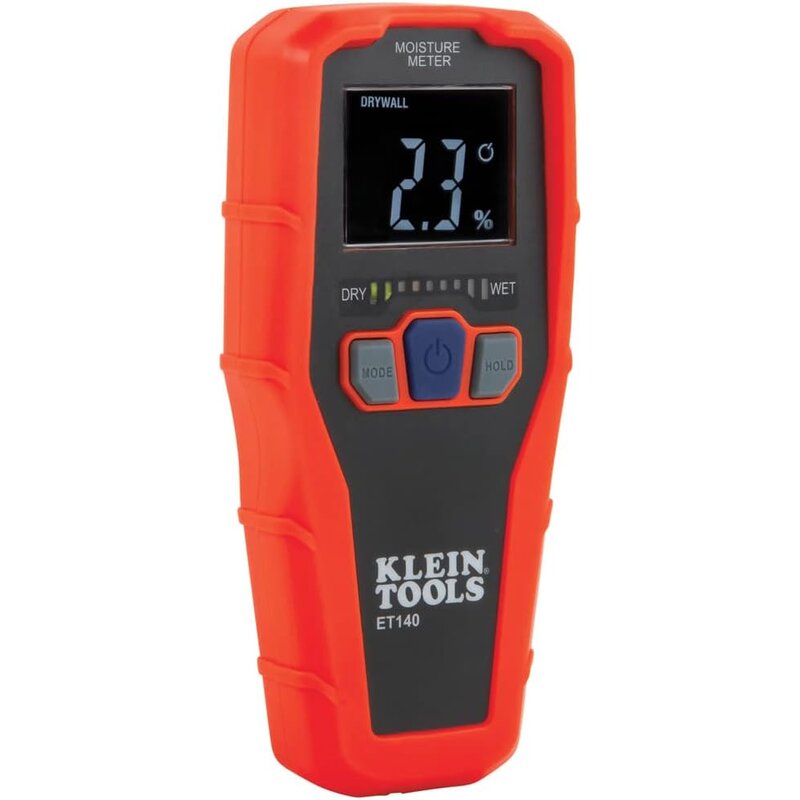
Klein Tools ET140 Pinless Moisture Meter
Image courtesy of Klein Tools

Klein Tools ET140 Pinless Moisture Meter

from Klein Tools
Rating
8.4 / 10
★★★★☆
Accuracy & Range
74%
Ease of Use
90%
Build Quality
88%
Versatility
88%
Value
88%

The Klein Tools ET140 is the most practical choice here for homeowners, inspectors and contractors who check more than just lumber. One switch selects hardwood, softwood, drywall or masonry, and the pinless sensor reads up to 3/4 inch deep without poking holes in finished walls, cabinets or trim.

That makes it a quick way to trace a damp area under a sink, around a window or behind a shower wall. Sweeping it across a wall and watching where readings rise is far faster than cutting test holes, and buyers often mention it is intuitive straight out of the package.

It is built like Klein's tester line, with a 6.6-foot drop rating, a reverse-contrast display and LED bar graph that read well at an angle, and a 7-ounce weight with its 9V battery. Compared with the Wagner Orion 930, it trades species settings for drywall and masonry modes.

The trade-off is precision. Klein rates wood accuracy at plus or minus 4 percent, and drywall and masonry readings are relative, best for comparing a wet spot against a dry one. There is no species correction beyond hardwood and softwood, so for fine furniture work choose a meter above; for leak hunting and renovation, it is excellent.


Pros
  • Reads wood, drywall and masonry
  • Pinless, so no holes in finished surfaces
  • Up to 3/4-inch sensing depth
  • 6.6-foot drop protection
  • Clear reverse-contrast display with bar graph
  • Light 7-ounce body
Cons
  • Wood accuracy of plus or minus 4% is modest
  • Drywall and masonry readings are relative only
  • No individual species corrections
  • Not suited to fine furniture work
PICK #5
General Tools MMD4E Digital Moisture Meter
Image courtesy of General Tools

General Tools MMD4E Digital Moisture Meter

from General Tools
Rating
8.0 / 10
★★★★☆
Accuracy & Range
72%
Ease of Use
86%
Build Quality
72%
Versatility
82%
Value
94%

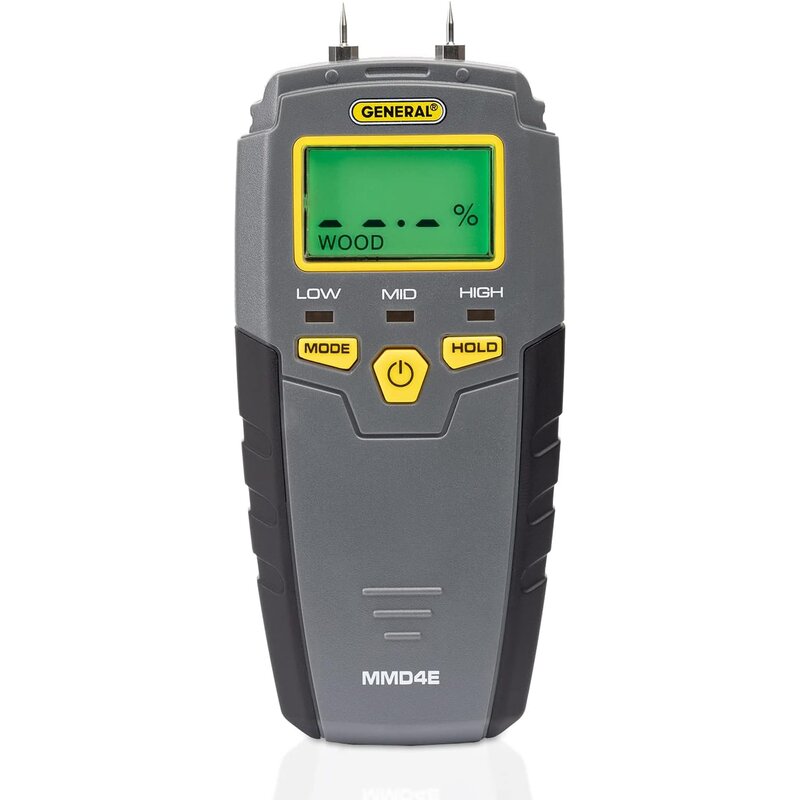
The General Tools MMD4E is the meter to buy if you want useful readings without spending much. It is a pin meter with a switch for wood or building materials, covering a wide 5 to 50 percent on wood and 1.5 to 33 percent on materials like drywall and concrete, so one tool handles woodworking and household checks.

Audible low, medium and high tones plus on-screen icons let you read a result at a glance, so you do not need to memorize target numbers when checking split firewood, a deck board before staining, or drywall after a leak.

The backlit 99.9-count LCD is easy to read in a dark crawlspace, the meter shuts off after three minutes to save its 9V battery, and it fits in a jacket pocket. Compared with the pinless Klein ET140, it reads building materials with pins, and it lacks the refinement of the Lignomat and Delmhorst.

You do give up refinement. The pins are short at 0.3 inch, so readings reflect the outer layer of thicker boards, and with no species corrections, values for dense or unusual woods are approximate. Retailers publish slightly different accuracy figures, and buyers note a lighter-duty build than the premium meters above. For occasional use, it delivers solid value.


Pros
  • Wide wood range of 5% to 50%
  • Separate mode for building materials
  • Audible low, medium and high moisture tones
  • Backlit display for dark spaces
  • Compact, with auto power-off to save the battery
Cons
  • Short 0.3-inch pins read only the outer layer
  • No species-specific corrections
  • Readings on dense or unusual woods are approximate
  • Retailers publish slightly different accuracy figures
  • Lighter-duty construction than pro meters

❓ What Is a Wood Moisture Meter

A wood moisture meter is a handheld tool that measures how much water is held in wood, shown as a percentage of moisture content. It tells you whether lumber, firewood or building materials are dry enough to use, finish, burn or cover.

There are two main types. Pin meters push two metal pins into the wood and measure electrical resistance between them; they read at a specific depth and work on rough or uneven surfaces, but leave small holes. Pinless meters press a flat sensor pad against the surface and use electromagnetic signals to scan below it without marking the wood, which suits finished boards and quick checks across large areas.

Accuracy depends on calibration and species settings, because different woods conduct electricity differently. Better meters include corrections for many wood species, temperature compensation and hold functions, and some also offer modes for drywall and other building materials. Combination meters offer both pin and pinless sensing in one tool.

Woodworkers, furniture makers, flooring installers, carpenters, home inspectors and contractors use moisture meters, as do people seasoning and selling firewood who want to know when it is ready to burn. Many keep a meter in the shop to check each new batch of lumber before starting a project.

⭐ Benefits of Wood Moisture Meter

Things To Consider When Choosing the Best Wood Moisture Meter

What To Avoid When Choosing Wood Moisture Meter

Discover Top Wood Moisture Meter
Owen Carter
Owen Carter – Research Specialist
Owen Carter is a research specialist at CompareLoft. He builds each guide by comparing manufacturer specifications, safety listings, warranty terms and patterns in verified buyer reviews. CompareLoft does not lab-test products; scores are editorial judgments based on that research.